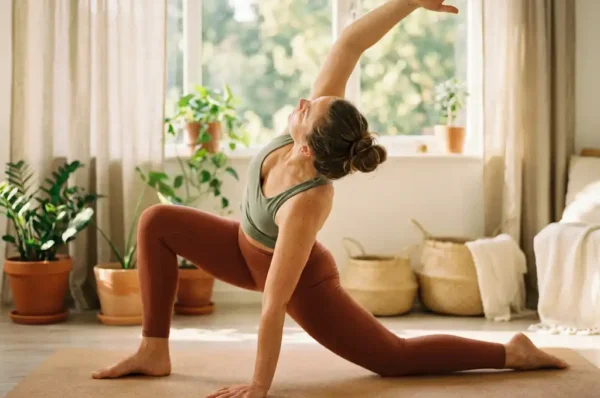



Vinyasa and Ashtanga are both dynamic, movement-based yoga styles that link breath to movement, but they differ significantly in structure and flexibility. Ashtanga follows a fixed sequence of poses practiced in the same order every time, while Vinyasa yoga flows through sequences that vary from class to class and teacher to teacher. If you are trying to decide which suits you best, understanding these core differences will make that choice much easier.
Which yoga style is more structured — Vinyasa or Ashtanga?
Ashtanga is considerably more structured than Vinyasa yoga. Ashtanga follows a precise, predetermined series of postures — the Primary Series, Second Series, and so on — that never change. Every session follows the same sequence, the same transitions, and the same pacing. Vinyasa yoga, by contrast, is fluid and flexible, with sequences shaped by the teacher’s creativity and the class’s energy.
In an Ashtanga class, you will practice the exact same poses in the exact same order every single time. This consistency is intentional. Practitioners believe that repeating the same sequence builds deep familiarity with the body, sharpens focus, and accelerates progress. Over months and years, you notice subtle shifts in your strength, flexibility, and mental clarity that would be harder to track in a more variable practice.
Vinyasa yoga, on the other hand, is defined by its variety. A Vinyasa class might open with sun salutations, move through a creative sequence of standing poses, and close with restorative stretches — but the specific combination changes every time. This makes Vinyasa feel fresh and engaging, but it also means the practice depends heavily on the teacher’s skill and intention.
How does the breathing differ between Vinyasa and Ashtanga?
Both Vinyasa and Ashtanga use breath as the foundation of movement, but Ashtanga applies a more specific breathing technique. Ashtanga requires Ujjayi pranayama — a controlled, audible breath created by slightly constricting the throat — throughout the entire practice. Vinyasa yoga also encourages Ujjayi breath, but teachers vary in how strictly they apply it, and the emphasis on breathwork differs from class to class.
In Ashtanga, the breath is not just a guide — it is the engine. Each movement is assigned a specific inhale or exhale, and you are expected to match them precisely. This creates a meditative, rhythmic quality that many practitioners describe as a moving meditation. The breath becomes the thread that holds the entire practice together.
In Vinyasa yoga, the principle is the same — movement flows with breath — but the application is more relaxed. A Vinyasa teacher might cue breath broadly, encouraging you to inhale as you lengthen and exhale as you fold, without the strict one-breath-per-movement precision of Ashtanga. This makes Vinyasa more accessible for those still developing their breath awareness.
Which is better for beginners — Vinyasa or Ashtanga?
For most beginners, Vinyasa yoga is the more accessible starting point. Because Vinyasa sequences vary and can be adapted by the teacher, classes can be tailored to different fitness levels and experience levels. Ashtanga’s fixed sequence is demanding and assumes a baseline of physical fitness and body awareness that many newcomers have not yet developed.
That said, some beginners thrive in Ashtanga precisely because of its structure. If you enjoy clear rules, predictable progression, and the satisfaction of mastering a set routine, Ashtanga’s consistency can feel motivating rather than overwhelming. Many Ashtanga studios offer Mysore-style classes, where you practice at your own pace with individual guidance from the teacher — a surprisingly beginner-friendly format once you understand how it works.
Vinyasa yoga tends to be more forgiving in the early stages because teachers can offer modifications on the fly, and no two classes feel identical, which keeps beginners engaged. If you are just starting out and want to explore movement, breath, and flexibility without the pressure of a strict system, a beginner Vinyasa class is an excellent first step. Pairing your practice with a supportive yoga mat that provides grip and cushioning will also make those early sessions more comfortable.
Should you choose Vinyasa or Ashtanga for your practice?
Choose Ashtanga if you value discipline, consistency, and a structured path of progression. Choose Vinyasa yoga if you prefer variety, creative sequencing, and a more flexible approach to your practice. Neither style is objectively better — the right choice depends on your personality, goals, and what keeps you coming back to the mat.
Ask yourself a few honest questions. Do you find repetition motivating or boring? Are you drawn to a practice with clear milestones, or do you prefer the freedom to explore? Do you want a practice you can do independently at home, or do you enjoy the unpredictability of a teacher-led class?
If discipline and self-mastery appeal to you, Ashtanga offers a deeply rewarding long-term path. The same sequence, practiced daily over years, reveals layers of depth that a varied practice cannot replicate in the same way. Many serious practitioners describe Ashtanga as a lifelong commitment rather than just a fitness routine.
If creativity and adaptability matter more to you, Vinyasa yoga fits naturally into a busy, varied lifestyle. You can find Vinyasa classes at virtually every level, in studios and online, and the range of styles within Vinyasa — from slow flow to power Vinyasa — means you can always find something that matches your energy on any given day.
Many practitioners eventually try both and draw from each. Whatever direction you choose, investing in quality yoga essentials that support your practice will make the experience more grounded and enjoyable from day one.
Frequently Asked Questions
Can I switch between Vinyasa and Ashtanga, or should I stick to one style?
Absolutely — many practitioners cross-train in both styles, and doing so can actually accelerate your overall growth. Ashtanga builds discipline, body awareness, and breath precision, while Vinyasa keeps your practice creative and adaptable. There are no rules against practicing both, and many yogis find that the structure of Ashtanga deepens their Vinyasa flow, while Vinyasa’s variety keeps Ashtanga from feeling monotonous.
How often should I practice Ashtanga or Vinyasa to see real progress?
For Ashtanga, the traditional recommendation is six days a week, though most modern practitioners aim for three to five sessions to balance intensity with recovery. For Vinyasa, two to four sessions per week is a solid starting point that allows your body to adapt without overtraining. Consistency matters far more than frequency — even two focused sessions per week will produce noticeable improvements in strength, flexibility, and breath awareness over time.
What is a Mysore-style Ashtanga class, and is it suitable for someone who has never done yoga before?
Mysore-style is a self-paced Ashtanga format where students practice the sequence independently in a shared room while the teacher circulates to offer individual adjustments and guidance. It can actually be one of the most beginner-friendly formats available, because you learn the sequence gradually — pose by pose — at your own pace rather than trying to keep up with a group. If you are curious about Ashtanga but worried about falling behind in a led class, Mysore is worth exploring as your entry point.
What are the most common mistakes beginners make when starting Vinyasa yoga?
The most common mistake is rushing through transitions to keep up with the class while neglecting breath alignment — which defeats the core purpose of Vinyasa. Many beginners also skip modifications and attempt advanced variations too soon, increasing the risk of injury. Start by focusing on matching one breath to one movement, use props without hesitation, and choose classes labeled ‘beginner’ or ‘all levels’ until your foundation is solid.
Is Ashtanga yoga safe if I have limited flexibility?
Yes — limited flexibility is not a barrier to starting Ashtanga, and the practice itself is one of the most effective ways to build it over time. The Primary Series, in particular, is designed as a progressive sequence that systematically opens the hips, hamstrings, and spine. The key is patience: work within your current range of motion, use props where needed, and avoid forcing poses. Flexibility in Ashtanga is earned gradually through consistent, mindful repetition rather than aggressive stretching.
How do I know if a Vinyasa class is the right difficulty level for me?
Most studios and online platforms classify Vinyasa classes by level — beginner, intermediate, or advanced — and these labels are a reliable starting guide. As a general rule, if you are regularly unable to follow the sequence or feel pain (rather than productive challenge) during class, the level is too high for now. If you can complete the class comfortably while maintaining steady breath and good form, it may be time to step up to the next level.
Can I practice Ashtanga or Vinyasa yoga at home without a teacher?
Vinyasa is well-suited to home practice thanks to the abundance of high-quality online classes available at every level, making it easy to follow along with a teacher virtually. Ashtanga can also be practiced at home once you have memorized the sequence — in fact, home practice is a core part of the traditional Ashtanga path. However, both styles benefit greatly from in-person instruction in the early stages, as a teacher can catch alignment issues and breathing habits that are difficult to self-assess, especially as a beginner.