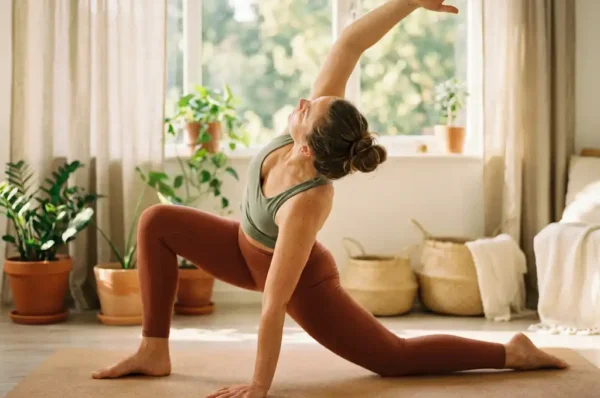



Vinyasa yoga is absolutely suitable for beginners, but it does require some patience and a willingness to start slowly. Unlike more static styles, vinyasa links breath to movement in a flowing sequence, which can feel fast-paced at first. The good news is that with the right preparation and a few smart modifications, beginners can practice vinyasa safely and enjoyably from day one. Below, we answer the most common questions new students have before stepping onto the mat.
Can beginners do vinyasa yoga safely?
Yes, beginners can do vinyasa yoga safely as long as they approach the practice with awareness and choose beginner-friendly classes. Vinyasa is not an advanced-only style, but its continuous flow means new students need to listen to their bodies, resist the urge to keep up with experienced practitioners, and prioritize form over speed from the very start.
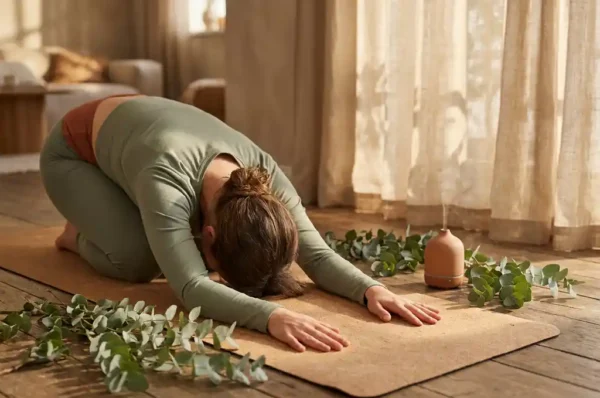
The key to a safe start is selecting a class labeled “beginner vinyasa” or “slow flow,” where the teacher breaks down transitions and offers modifications. Many studios and online platforms offer exactly this, and a good instructor will remind you regularly that resting in child’s pose is always an option. The flowing nature of vinyasa can actually be a gift for beginners because the rhythm of breath and movement helps you stay present rather than overthinking each pose.
One practical step is investing in a supportive, grippy mat before your first class. A natural rubber yoga mat provides the traction and cushioning that help beginners feel stable during transitions, which reduces the risk of slipping and builds confidence on the mat.
What makes vinyasa yoga harder than other yoga styles?
Vinyasa yoga is harder than many other yoga styles primarily because of its continuous, breath-linked movement. Unlike Hatha yoga, where poses are held for extended periods with rests in between, vinyasa keeps you moving from one posture to the next with minimal pausing. This demands cardiovascular endurance, coordination, and body awareness all at once.
Several factors contribute to the added challenge:
- Pacing: Classes move quickly, leaving little time to figure out alignment before the sequence progresses.
- Breath coordination: Synchronizing inhales and exhales with specific movements is a skill that takes time to develop naturally.
- Upper body strength: Transitions like chaturanga (a low push-up position) require significant shoulder and arm strength that most beginners are still building.
- Memorization: Unlike Bikram or Iyengar yoga, vinyasa sequences vary from class to class, so you cannot rely on familiarity with a set routine.
- Core engagement: Holding the body stable through flowing transitions demands consistent core activation throughout the entire practice.
None of these challenges make vinyasa off-limits for beginners. They simply explain why it can feel demanding at first and why building a foundation beforehand is genuinely worthwhile.
What should beginners learn before their first vinyasa class?
Before attending a vinyasa class, beginners benefit most from learning a handful of foundational poses and understanding how to connect breath to movement. You do not need to master yoga before trying vinyasa, but familiarity with a few key shapes will help you follow along without feeling lost or frustrated.
Core poses to practice first
Focus on the postures that appear in almost every vinyasa sequence. Downward-facing dog, plank pose, low cobra or upward-facing dog, warrior one, and warrior two form the backbone of most flows. Spend time in each of these individually so your body knows the shape before you are asked to move through them at pace. Even a week of short daily practice with these poses makes a noticeable difference.
Breath awareness before movement
Vinyasa yoga is built on the principle that each movement is driven by either an inhale or an exhale. Practicing simple breath awareness, even just sitting quietly and noticing the natural rhythm of your breathing, prepares you to layer movement on top. A useful exercise is pairing a seated forward fold with an exhale and a gentle backbend with an inhale, repeating this a few times until the connection starts to feel intuitive.
If you want to explore your practice more broadly, browsing our range of yoga essentials can help you arrive at your first class feeling prepared and equipped.
How do you modify vinyasa poses as a beginner?
Beginners modify vinyasa poses by using props, reducing range of motion, and substituting challenging transitions with gentler alternatives. Modifications are not a sign of weakness; they are how experienced yogis protect their bodies and build strength progressively. Every pose in a vinyasa sequence has at least one beginner-friendly variation.
Here are the most useful modifications to keep in mind:
- Chaturanga: Lower your knees to the mat before bending your elbows. This removes most of the shoulder load while still building the arm and core strength you need for the full version later.
- Downward-facing dog: Bend your knees generously if your hamstrings are tight. A slight bend keeps the spine long, which is far more important than straight legs.
- Warrior sequences: Shorten your stance to reduce intensity in the hips and thighs. A shorter stance also makes balancing easier while your body adapts.
- Transitions: Step your foot forward from downward dog rather than jumping it. Jumping requires significant core control and is entirely optional for beginners.
- Rest: Return to child’s pose whenever you need a moment to breathe and reset. This is always available to you regardless of what the rest of the class is doing.
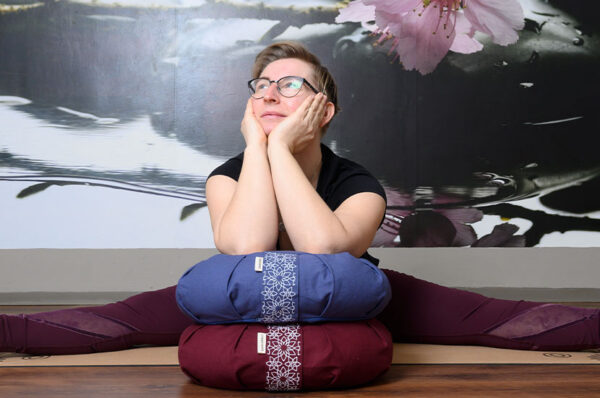
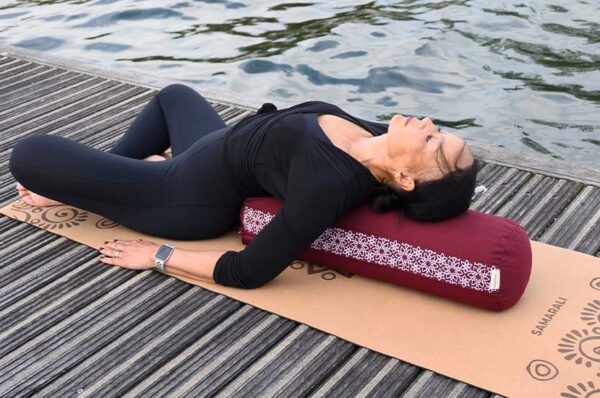
Props also make a significant difference. A yoga bolster supports the body in restorative variations, and folded blankets under the knees or hips can make floor-based transitions far more comfortable. Using props consistently as a beginner is one of the smartest habits you can build, and it is something even advanced practitioners rely on for a more intentional practice.
Frequently Asked Questions
How often should beginners practice vinyasa yoga to see real progress?
For beginners, practicing vinyasa yoga 2–3 times per week strikes the ideal balance between building consistency and allowing your body adequate recovery time. Muscles, joints, and connective tissue all need time to adapt to the new demands of flowing movement, so rest days are just as important as practice days. Within 4–6 weeks of regular practice at this frequency, most beginners notice meaningful improvements in strength, breath coordination, and confidence during transitions.
What should I do if I can't keep up with the pace of a vinyasa class?
If the class moves faster than you can follow, the best strategy is to simplify rather than rush — skip a transition, hold a pose an extra breath, or rest in child’s pose until the group reaches a familiar shape you can rejoin. Trying to keep up at the cost of your form is the most common beginner mistake and the leading cause of early frustration and injury. Over time, the sequences will start to feel more familiar and your body will naturally begin to match the pace without forcing it.
Is online vinyasa yoga effective for beginners, or is an in-person class better?
Both formats can work well for beginners, but they come with different trade-offs. In-person classes give you access to a teacher who can physically correct your alignment and offer real-time modifications, which is especially valuable when you are still learning foundational poses. Online classes, on the other hand, offer the flexibility to pause, rewind, and practice at your own pace, which can actually reduce the pressure beginners often feel in a live group setting. Ideally, combining both — using online beginner flows to build familiarity and attending occasional in-person classes for alignment feedback — gives you the best of both worlds.
What are the most common mistakes beginners make in vinyasa yoga?
The three most common beginner mistakes are holding the breath, collapsing through the shoulders in chaturanga, and skipping the warm-up. Forgetting to breathe — or breathing shallowly — breaks the fundamental connection that makes vinyasa work and often leads to tension building up in the neck and shoulders. Dropping into chaturanga without the necessary upper body strength puts significant strain on the rotator cuff, so the knee-down modification should be used without hesitation until that strength develops. Starting class cold without gentle warm-up movements also increases the risk of strain in the hips and hamstrings during early standing sequences.
Can vinyasa yoga help with weight loss or is it mainly for flexibility?
Vinyasa yoga can genuinely support weight loss because its continuous, flowing nature elevates the heart rate in a way that more static yoga styles do not, making it a legitimate cardiovascular workout alongside its flexibility benefits. A 60-minute vinyasa class can burn anywhere from 400 to 600 calories depending on the intensity and the individual, which is comparable to a moderate cycling or swimming session. That said, the most lasting physical benefits beginners tend to notice first are improved posture, core stability, and functional flexibility — all of which support a healthier, more active lifestyle beyond the mat.
Do I need to be flexible to start vinyasa yoga?
No — flexibility is a result of practicing yoga, not a prerequisite for starting it. One of the most persistent myths about yoga is that you need to already be flexible to join a class, but every experienced yogi was once a stiff beginner. The modifications covered in this post, such as bending the knees in downward dog or shortening your stance in warrior poses, exist precisely so that practitioners at every flexibility level can participate safely and benefit fully from the practice.
How long does it typically take for vinyasa yoga to start feeling natural?
Most beginners find that after 8–12 consistent classes, the core sequences begin to feel recognizable and the breath-movement connection starts to click into place. The first 3–4 classes are typically the steepest part of the learning curve, where everything feels unfamiliar and slightly overwhelming — this is completely normal and not a reflection of your ability. Keeping a brief journal of how each class felt can be a motivating way to track your progress and notice how quickly things that once felt difficult begin to feel effortless.