


Tall people typically need yoga mats that are at least 78–84 inches long, compared to standard 68–72 inch mats. If you’re over 6 feet tall, an extra-long mat prevents your head or feet from hanging off during poses, ensuring proper alignment and safety. The right mat length depends on your height and the yoga styles you practice. If you have ever found yourself mentally recalculating your position mid-flow, or noticed your heels grazing cold floor during Savasana, your mat is not supporting your practice — it is limiting it.
What yoga mat length do tall people actually need?
Practitioners over 6 feet tall generally need mats measuring 78–84 inches in length to accommodate their full body during various poses. Standard yoga mats typically measure 68–72 inches, which leaves taller yogis with insufficient space for proper alignment and comfort.
Your height directly affects mat selection because yoga involves lying down, stretching in both directions, and extending your body fully. When you’re in poses like Savasana (corpse pose) or Warrior I, your entire body should rest comfortably on the mat surface. A good rule of thumb: add 6–12 inches to your height when selecting mat length.
Here’s a complete sizing guide covering length, width, and thickness by height range:
- 5’6″ to 6’0″: Length: Standard 72 inches — Width: 24 inches — Thickness: 4–5mm. Standard mats usually work well for most poses and provide adequate space for comfortable practice.
- 6’0″ to 6’4″: Length: 78 inches (extra-long) — Width: 26 inches — Thickness: 5–6mm. Choose an extra-long mat to ensure full body coverage during extended poses and flowing sequences.
- 6’4″ and above: Length: 84 inches or longer — Width: 28–30 inches — Thickness: 6mm+. Look for specialty mats to accommodate your full frame and prevent any body parts from extending beyond the mat’s surface.
These recommendations cover most practitioners, but proportions matter too. Broader shoulders or wider hips may push you toward the next width tier regardless of height, so treat the guide as a starting point and adjust based on your individual build.
How do you know if your yoga mat is too short for your practice?
Several clear signs indicate when your current mat is holding you back:
- Body parts extending beyond the mat: Your head, hands, or feet regularly touch the floor during poses, creating instability and discomfort.
- Compromised alignment: You scrunch up or modify poses not for physical reasons, but to fit within the mat’s boundaries.
- Safety concerns during transitions: Slipping risks increase when your hands or feet land on bare floor instead of the mat’s grippy surface, particularly in dynamic poses.
- Constant repositioning: You spend practice time adjusting your position rather than focusing on breath and movement.
- Mental distraction: Worrying about staying on your mat prevents you from fully engaging in the meditative aspects of yoga.
These issues become more pronounced depending on the style you practice. Vinyasa and Ashtanga highlight space limitations through dynamic movement, while Yin yoga makes cramped positioning especially uncomfortable during long holds. When your mat becomes a barrier rather than a support, it’s time to size up.
How to test whether a yoga mat fits your body: four poses to try
If you are unsure whether your current mat is the right size, the most reliable way to find out is to move through a few key poses and observe what happens at the edges. This simple self-assessment gives you a concrete, body-specific answer that no height chart can fully replace.
Savasana: the full-body length test
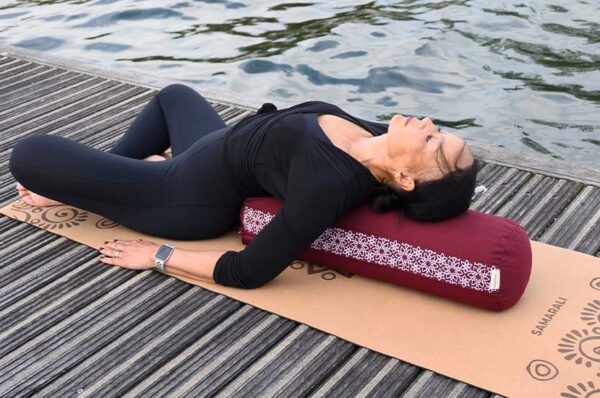
Lie flat on your back with your arms resting slightly away from your sides and your legs extended naturally. In a correctly sized mat, the crown of your head and your heels should both rest fully on the surface with at least two inches of clearance at each end. If your feet hang off the bottom edge or you must tuck your chin forward to stay on the mat, you need at least 78 inches — and possibly 84 inches if you are 6’4″ or taller. This is the clearest single indicator of whether a mat is long enough for your body.
Downward Facing Dog: the length and width test
Press into Downward Dog and check whether both your hands and your feet land fully on the mat, with no part of your palm or heel touching bare floor. A well-fitted mat keeps your entire hand and foot planted, giving your grip something to work with throughout the pose. If your heels or the base of your palms slip off the edge, your mat is too short. If your hands feel crowded toward the center, it may also be too narrow for your shoulder width.
Chaturanga Dandasana: the diagonal space test
Move through a full Chaturanga and notice whether your toes remain on the mat as you lower your chest toward the floor. Tall practitioners have a longer torso-to-leg ratio, so the diagonal distance from hands to feet in this pose often exceeds what a standard mat provides. If your toes slide onto bare floor as you lower down, that is a reliable signal you need an extra-long mat.
Prasarita Padottanasana: the width and lateral reach test
Step your feet wide apart into Prasarita Padottanasana and check whether both feet land fully within the mat’s width. For tall practitioners, a wider stance is natural, and a standard 24-inch mat often cannot accommodate it. If either foot steps onto bare floor, a 26- to 30-inch wide mat will serve your practice significantly better — particularly in standing wide-leg poses and seated lateral stretches.
What tall yogis say about switching to an extra-long mat
Tall practitioners consistently report that switching to an extra-long mat is one of the most immediately noticeable improvements they have made to their practice.
“I had been practicing Vinyasa for about four years on a standard mat, constantly shuffling forward before every Savasana. The moment I tried an 84-inch mat, I realized how much mental energy I had been wasting just managing my position. Now I can actually focus on my breath.” — James, 6’3″, 4 years of practice
“Yin yoga is all about surrendering into long holds, but I could never fully relax because my feet were always hanging off the edge. Switching to a 78-inch mat changed everything — I finally understood what people meant by a restorative practice.” — Sofia, 6’0″, 2 years of practice
“As someone just starting out, I assumed the discomfort was part of learning. It turned out my mat was simply too short for my body. Getting a properly sized mat made the poses feel achievable instead of awkward.” — Marcus, 6’2″, beginner
The most common feedback we hear from tall practitioners who switch centers on the same theme: the removal of a low-level distraction they had not fully realized was there. When the mat fits, the practice can begin.
What’s the difference between standard and extra-long yoga mats?
The key differences between standard and extra-long yoga mats go beyond measurements:
- Dimensions and coverage: Standard mats measure 68–72 inches long and 24 inches wide. Extra-long versions extend to 78–84 inches, adding 6–12 inches of usable space.
- Weight and portability: Extra-long mats typically weigh 0.5–1 pound more and need larger storage solutions, though most practitioners find this trade-off worthwhile.
- Cost: Longer mats generally cost 20–30% more than standard sizes due to increased material usage and specialized manufacturing.
- Material consistency: Quality manufacturers use identical materials and construction methods across sizes, so grip, cushioning, and durability remain consistent.
- Storage: Extra-long mats need more space and may not fit in standard yoga mat bags or typical studio storage cubbies.
For tall practitioners, the benefits of proper sizing outweigh these practical considerations. Better alignment, improved safety, and a more focused practice make an extra-long mat a worthwhile investment — not a compromise.
Which yoga mat size do you need for your practice style?
Height is the starting point, but the yoga style you practice shapes the final decision just as meaningfully. Different styles place different demands on space, and for tall practitioners, those demands are amplified. Here is what to look for based on how you actually move on the mat.
Vinyasa and Power Yoga
For tall practitioners doing Vinyasa or Power Yoga, an 84-inch mat with at least 26 inches of width is the recommended starting point. Dynamic flows involve large transitions — lunging sequences, sweeping arm movements, rapid directional changes — that require both length and lateral space. If your mat is too short or too narrow, you will clip the edges at exactly the moments when you need your full attention on the movement. A mat for a tall Vinyasa practitioner should feel like a generous platform, not a tightrope.
Ashtanga
Ashtanga’s fixed primary series moves through a structured sequence of standing, seated, and prone poses that demand full-body coverage at every stage. For tall practitioners, a mat of 78–84 inches with a width of 24–26 inches covers the full range of the series comfortably. Because Ashtanga repeats the same sequence every session, any mat-fit issue will come up reliably — making it worth getting the right size from the start rather than adapting around one that doesn’t fit.
Yin and Restorative Yoga
Yin and Restorative yoga involve holding supine and prone positions for three to five minutes or longer, which makes full-body coverage essential — not optional. A minimum of 78 inches in length is necessary for tall practitioners in these styles. The inability to fully extend during a long hold creates cumulative physical tension that directly undermines the practice’s purpose. An extra-long mat for Yin yoga is less about dynamic space and more about the quality of stillness it enables: when your body fits the mat completely, you can finally let go.
Hot Yoga
Hot yoga adds one more variable that makes mat size even more critical: sweat. For tall practitioners, a mat of 78–84 inches with a moisture-resistant surface is strongly recommended. Sweat-slicked transitions increase the risk of hands and feet sliding off a too-short mat at the worst possible moments — creating both a safety concern and a practice disruption. Prioritize both length and a surface material, such as natural rubber or a microfibre top layer, that maintains grip as moisture builds throughout the session.
Where can tall people find sustainable yoga mats that fit properly?
Finding eco-friendly yoga mats in extra-long sizes requires knowing where to look and what certifications to seek:
- Material options: Natural rubber mats offer biodegradability and excellent grip. Cork-topped versions provide antimicrobial properties from sustainable harvesting.
- Certification standards: Look for OEKO-TEX Standard 100 (chemical-free materials), GREENGUARD (low emissions), and B Corp certification (comprehensive environmental responsibility).
- Lifecycle considerations: Evaluate manufacturing processes, plastic-free packaging, and end-of-life take-back programs offered by eco-conscious brands.
- Quality and cost: Sustainable mats often cost more upfront but last longer, reducing both replacement frequency and waste.
- Where to buy: Local eco-friendly stores and direct-to-consumer sustainable brands typically carry the best selection of properly sized, environmentally responsible options.
The sustainable yoga mat market has grown to meet the needs of environmentally conscious practitioners of all sizes. By choosing certified sustainable options, tall practitioners can find a properly fitted mat while supporting responsible manufacturing — and reducing their environmental impact at the same time.
Imagine your first practice on a mat that actually fits: no shuffling backward before Savasana, no clipped transitions in Downward Dog, no mental arithmetic about where your body ends and the floor begins. Just movement, breath, and space. That is what a properly sized mat gives you — and for tall practitioners, it is not a luxury, it is the baseline. We at Samarali understand this connection deeply, which is why all our yoga gear uses organic cotton materials and completely plastic-free packaging, ensuring your practice supports both personal growth and environmental stewardship.
Browse our selection of thoughtfully crafted sustainable yoga essentials — designed for mindful movement and made with respect for the planet.