


Yoga Nidra and sleep are not the same thing. Yoga Nidra is a guided meditative practice that induces a state of conscious relaxation between waking and sleeping, whereas sleep is an unconscious biological process. The key difference is awareness: during Yoga Nidra, you remain alert at a deep level, while in sleep, conscious awareness is absent.
Both states offer genuine rest and recovery, but they work through different mechanisms and serve different purposes. The sections below unpack exactly what happens in your brain, whether Yoga Nidra can substitute for sleep, how to time your sessions, and who stands to benefit most.
What actually happens to your brain during Yoga Nidra?
During Yoga Nidra, your brain transitions into a hypnagogic state, the threshold between waking and sleeping. Brain activity shifts from the fast beta waves of active thinking into slower alpha waves associated with relaxed awareness, and then into theta waves, the same low-frequency activity seen in the earliest stage of sleep. What makes Yoga Nidra distinct is that you maintain a thread of conscious awareness throughout this descent.
In ordinary sleep, you lose that thread entirely. Your brain cycles through several stages, including light sleep, deep slow-wave sleep, and REM sleep, with no deliberate awareness guiding the process. During Yoga Nidra, a facilitator’s voice or a recorded script acts as an anchor, keeping a small part of your mind engaged while the rest of your nervous system drops into deep rest.
This conscious descent into the theta state is significant because theta activity is linked to creativity, emotional processing, and the integration of new information. Practitioners often report vivid imagery, spontaneous insights, and a profound sense of release, experiences that feel different from waking meditation and different again from dreaming. The parasympathetic nervous system becomes dominant, heart rate slows, muscle tension releases, and the stress hormone cortisol decreases, producing measurable physical recovery alongside the mental stillness.
Can Yoga Nidra replace sleep?
Yoga Nidra cannot fully replace sleep. Sleep serves essential biological functions, including cellular repair, immune regulation, memory consolidation, and hormonal balance, that require the body to cycle through its full architecture of sleep stages over several hours. Yoga Nidra does not replicate those cycles, no matter how deeply restful it feels.
That said, Yoga Nidra offers a quality of rest that goes beyond ordinary relaxation. Many practitioners describe a single 30-minute session as leaving them feeling refreshed in a way that a 30-minute nap does not always achieve. This is partly because Yoga Nidra reaches the theta state more reliably and quickly than most people enter it during a short nap, and partly because the practice actively discharges accumulated mental and emotional tension.
Think of Yoga Nidra as a powerful complement to sleep rather than a substitute. If you are sleep-deprived, a Yoga Nidra session can ease fatigue and improve your ability to function, but it does not address the underlying physiological debt. Used alongside consistent, quality sleep, it becomes a genuinely restorative tool for managing stress, improving focus, and supporting overall well-being.
How long should a Yoga Nidra session be compared to a nap?
A typical Yoga Nidra session lasts between 20 and 45 minutes, and even a 20-minute session can deliver deep rest comparable in subjective quality to a longer nap. A conventional nap, by contrast, is most effective at either 10 to 20 minutes (a short power nap before entering deep sleep) or around 90 minutes (a full sleep cycle). Yoga Nidra sidesteps the grogginess risk that comes with waking mid-cycle because it keeps you at the threshold rather than pulling you into deep sleep.
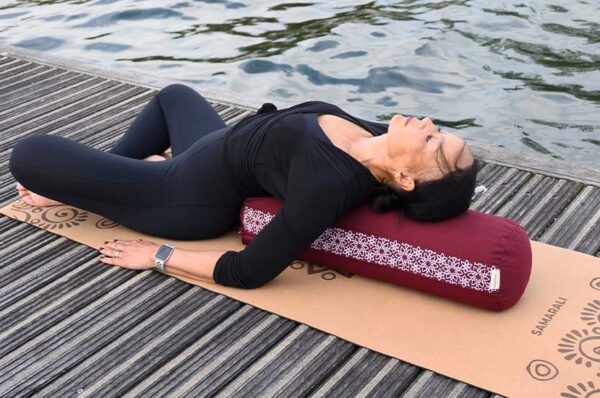
For beginners, a guided session of 20 to 30 minutes is a practical starting point. You simply lie down in a comfortable position, often called Savasana, and follow the audio guidance. A yoga bolster placed under your knees can make this position significantly more comfortable, especially for longer sessions, by releasing tension in the lower back.
If you are using Yoga Nidra during a lunch break or between work sessions, a 20-minute recording fits neatly into a short window without leaving you feeling disoriented. For deeper rest or stress recovery, a 40 to 45-minute session gives the practice more time to move through its stages, including body scan, breath awareness, visualization, and the setting of a personal intention called a Sankalpa.
Who benefits most from Yoga Nidra over conventional sleep aids?
People who struggle with stress-driven insomnia, chronic mental fatigue, or anxiety tend to benefit most from Yoga Nidra compared to conventional sleep aids. Unlike sleep medications, Yoga Nidra addresses the nervous system directly, training the body to shift out of the fight-or-flight state and into genuine rest without dependency, side effects, or morning grogginess.
Several groups find Yoga Nidra particularly well suited to their needs:
- High-stress professionals who carry mental tension into the evening and find it difficult to wind down, even when physically tired
- Shift workers or frequent travellers whose sleep schedules are irregular and who need a portable, flexible recovery tool
- Yoga and meditation practitioners who already have a mindfulness foundation and want to deepen their restorative practice
- People recovering from burnout who need rest that goes beyond passive lying down but cannot yet sustain active meditation
- Those new to meditation who find seated practices difficult, since Yoga Nidra requires no prior experience and no mental effort to “do it right”
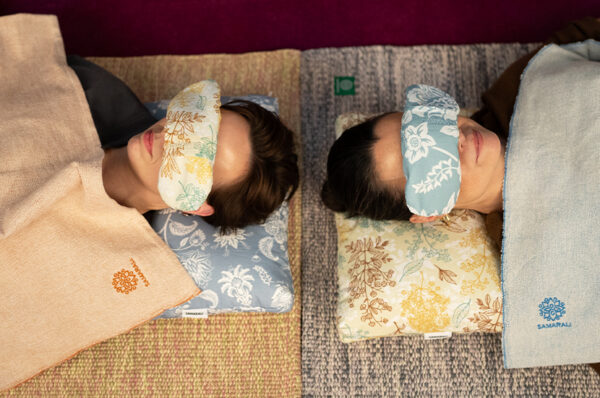
Yoga Nidra is also accessible in a way that many wellness practices are not. You do not need flexibility, strength, or a particular level of fitness. All you need is a quiet space, a comfortable surface, and ideally a few supportive props. A organic cotton yoga blanket draped over you during practice helps maintain body warmth as your temperature naturally drops in the relaxed state, keeping you comfortable enough to stay present without drifting into full sleep.
If you are exploring meditation as a broader part of your wellness routine, Yoga Nidra is one of the most accessible entry points available, offering deep rest, nervous system regulation, and a genuine sense of inner calm that conventional sleep aids simply cannot replicate.
Ready to create the ideal conditions for your Yoga Nidra practice? At Samarali, you will find everything you need to support deep, restorative rest. Settle into Savasana with a yoga bolster under your knees, stay warm and grounded with an organic cotton yoga blanket, or explore our full range of meditation sets designed to make every session as comfortable and focused as possible. Shop the meditation collection and find the props that help you go deeper.
Frequently Asked Questions
How do I know if I've actually entered the Yoga Nidra state or just fallen asleep?
The clearest sign that you’ve maintained the Yoga Nidra state is that you can recall the guidance or imagery from the session afterward. If you wake up with no memory of the audio after a certain point, you likely crossed into actual sleep, which is common for beginners and not a failure. Over time, with regular practice, you’ll develop the ability to stay at that conscious threshold longer. A gentle indicator during the session is that you can still hear the guide’s voice even while feeling deeply relaxed and heavy.
What's the best time of day to practice Yoga Nidra?
Yoga Nidra is flexible enough to be practiced at almost any time, but the most effective windows are mid-morning (after the initial alertness of the day has passed), early afternoon (around the post-lunch energy dip), or early evening as a transition between work and personal time. Practicing too close to bedtime can sometimes be counterproductive if your goal is to stay awake during the session, though many people do use it as a pre-sleep wind-down ritual with great success. Avoid scheduling it within an hour of waking, when your brain is still in a naturally theta-dominant state, as the contrast needed to make the practice effective is lower.
Can I practice Yoga Nidra if I have no meditation experience at all?
Absolutely — Yoga Nidra is widely considered one of the most beginner-friendly meditative practices available precisely because it requires no active mental effort. Unlike seated mindfulness or breathwork, you simply lie down and follow spoken instructions, so there’s nothing to ‘figure out’ or ‘get right.’ Your only job is to listen and stay awake, and even drifting into sleep occasionally is a normal part of the learning curve. Starting with a well-structured guided recording of 20–25 minutes is the most practical way to begin.
Is it normal to feel emotional or experience vivid imagery during a session?
Yes, and it’s actually one of the hallmarks of a deep Yoga Nidra state. The theta brainwave state you enter during practice is strongly associated with emotional processing and subconscious imagery, which is why spontaneous memories, feelings, or visual experiences often arise. These are signs that your nervous system is releasing stored tension, not that something is going wrong. If an emotion feels overwhelming, simply noticing it without engaging is enough — the practice is designed to let these experiences pass through naturally.
How often should I practice Yoga Nidra to notice real benefits?
Most practitioners begin noticing tangible benefits — improved sleep quality, reduced stress reactivity, and greater mental clarity — within two to three weeks of consistent daily or near-daily practice. Even three to four sessions per week can produce meaningful results over a month. The cumulative effect is significant: each session builds on the last by progressively training your nervous system to access deep rest more quickly and reliably. Consistency matters far more than session length, so a regular 20-minute practice will outperform occasional 45-minute sessions.
What's the difference between Yoga Nidra and other relaxation techniques like progressive muscle relaxation or guided visualization?
Progressive muscle relaxation (PMR) works primarily at the physical level by deliberately tensing and releasing muscle groups, while guided visualization keeps the mind engaged in imagined scenarios — both are effective but operate mainly in the alpha brainwave range. Yoga Nidra is more structured and goes deeper, systematically guiding you through body awareness, breath, sensation pairs, imagery, and a personal intention (Sankalpa) to reach the theta state. It also incorporates a specific rotation of consciousness through the body that is unique to the practice and has roots in the ancient Tantric tradition, making it both a relaxation tool and a meditative discipline in its own right.
Can Yoga Nidra help with sleep disorders like insomnia, or should I consult a doctor first?
Yoga Nidra has shown promising results as a complementary approach for stress-related insomnia, helping to reduce the hyperarousal of the nervous system that often underlies difficulty falling or staying asleep. It is generally safe for most people and carries no side effects, making it a low-risk addition to any wellness routine. However, if your insomnia is chronic, significantly impacting your daily functioning, or linked to an underlying medical condition such as sleep apnea or a mood disorder, consulting a healthcare professional is strongly recommended before relying on Yoga Nidra as a primary intervention. Think of it as a powerful supportive tool rather than a standalone treatment for clinical sleep disorders.