


The best yoga props for back pain in Yin Yoga are bolsters, blankets, and blocks. These tools allow you to support the spine, reduce compression in sensitive areas, and hold poses for longer without straining muscles or joints. If you have a sensitive lower back, the right props can make the difference between a practice that heals and one that aggravates. Below, we answer the most common questions about using props to protect your back in Yin Yoga.
Which Yin Yoga poses are most likely to cause back pain?
The Yin Yoga poses most likely to cause back pain are deep forward folds, spinal twists, and poses that involve strong lumbar compression, such as Saddle, Dragon, and Caterpillar. These postures target the connective tissue around the spine and hips, which can be beneficial but also risky if the body is not properly supported or prepared.
In Saddle pose, the lumbar spine moves into deep extension, which can feel intense for anyone with tight hip flexors or existing lower back tension. Dragon (a deep lunge variation) places significant load on the hip flexors and sacrum. Caterpillar, a seated forward fold, rounds the entire spine and can create strain if the hamstrings are very tight, as the pelvis tilts backward and pulls on the lower back.
The key issue in Yin Yoga is that poses are held for two to five minutes. This extended hold means that even mild discomfort can build into real pain if the body is not well-positioned from the start. Recognising which poses challenge your back gives you the opportunity to modify them before discomfort sets in.
What props are best for supporting the lower back in Yin Yoga?
The best props for supporting the lower back in Yin Yoga are bolsters, folded blankets, and yoga blocks. Each serves a slightly different purpose, but all three work by reducing the range of motion in a pose so the spine stays in a safer, more neutral position during long holds.
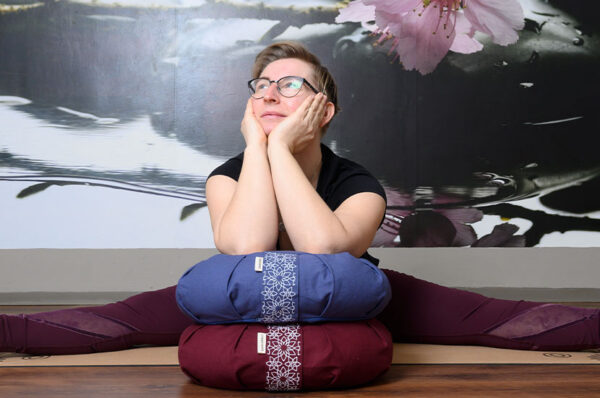
- Bolster: Ideal for poses like Supported Bridge, Reclined Butterfly, and gentle backbends. A bolster placed under the sacrum or along the spine offloads pressure and encourages passive opening without compression.
- Folded blanket: Useful under the hips in seated poses to tilt the pelvis forward, which reduces rounding in the lower back. An organic cotton yoga blanket works particularly well because it can be folded to different thicknesses depending on your needs.
- Yoga blocks: Helpful in poses like Sleeping Swan or Dragon to raise the floor and shorten the distance the body needs to travel, keeping the spine from collapsing under its own weight.
Using props is not a sign of weakness or limitation. In Yin Yoga, props are a core part of the practice, helping you stay in a pose long enough to reach the deeper layers of connective tissue without putting the muscles or joints under unnecessary stress.
How do you use a bolster to relieve back pain in Yin Yoga?
To use a bolster for back pain in Yin Yoga, place it under the sacrum, along the spine, or beneath the knees depending on the pose. The goal is to create a supported shape that allows the body to release passively without the spine bearing load. Positioning matters more than the specific pose you are doing.
Under the sacrum in Supported Bridge
Lie on your back, bend your knees, and lift your hips slightly. Slide the bolster under your sacrum (the flat bone at the base of your spine, just above the tailbone). Lower your hips onto the bolster and let the weight of your body settle. This gently opens the front of the hips and decompresses the lumbar spine without requiring any muscular effort.
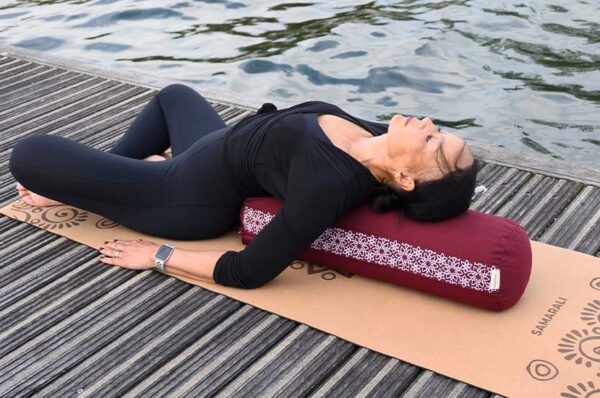
Along the spine in Supported Fish
Place the bolster lengthwise on your mat and sit in front of it. Slowly recline so your spine rests along the bolster, with your head supported either by the bolster or by an additional folded blanket. This shape opens the chest and upper back while keeping the lower back in a comfortable, supported extension. Our yoga bolster is designed with this kind of restorative use in mind, offering firm yet comfortable support for extended holds.
In both cases, give yourself a moment after settling into the pose to check in with your lower back. There should be a sense of gentle stretch or release, not sharp pressure or pinching. If anything feels uncomfortable, adjust the height by adding or removing a folded blanket beneath the bolster.
Should you skip Yin Yoga altogether if you have back pain?
No, you should not skip Yin Yoga altogether if you have back pain. For many people, a well-supported Yin practice can actually help relieve chronic lower back tension by gently releasing the fascia and connective tissue around the hips, pelvis, and spine. The key is to modify poses, use props generously, and avoid any shape that causes sharp or shooting pain.
There is an important distinction between productive discomfort and harmful pain. A mild ache, a sense of stretch, or a feeling of release in the hips or lower back is generally safe and often beneficial. Sharp pain, tingling, numbness, or pain that radiates down the legs are signals to come out of a pose immediately and consult a healthcare professional before continuing.
If you are recovering from a specific injury such as a herniated disc or sacroiliac joint dysfunction, it is worth speaking to a physiotherapist before starting or resuming a Yin practice. They can advise which poses to avoid and which are safe with modification. Once you have that guidance, Yin Yoga can become a genuinely supportive part of your recovery and long-term back health.
Ready to build a back-friendly Yin Yoga practice at home? At Samarali, you will find everything you need to practice safely and with confidence. From our supportive yoga bolster and organic cotton yoga blanket to our full yoga collection, each piece is chosen with mindful, sustainable practice in mind. Shop now and give your back the support it deserves.
Frequently Asked Questions
How many props do I actually need to start a back-friendly Yin Yoga practice at home?
You can get started with just two essentials: a bolster and a folded blanket. These two props cover the majority of lower back modifications across common Yin poses. As your practice deepens, adding a set of yoga blocks gives you even more flexibility to adjust poses like Dragon and Sleeping Swan, but they are not strictly necessary on day one.
How do I know if I'm positioning my props correctly, or if I'm making the back pain worse?
The right prop placement should create a sense of ease, passive release, or gentle stretch — not increased pressure or discomfort. A reliable check is to scan your lower back 30 to 60 seconds after settling into a supported pose: if the sensation is softening or staying neutral, your setup is working. If you feel sharpness, pinching, or the discomfort is building rather than easing, come out of the pose and adjust the height or angle of your prop before trying again.
Can I substitute household items like pillows or folded towels if I don't have yoga props?
Yes, household items can work as a starting point — firm sofa cushions can substitute for a bolster, and tightly folded bath towels can replace a yoga blanket under the hips. The main limitation is consistency: household items tend to compress unevenly or shift during long holds, which can subtly alter your spinal alignment. If you practice regularly with back pain, investing in purpose-built props is worthwhile because the firmness and shape are specifically designed to maintain support throughout a five-minute hold.
Are there any Yin Yoga poses I should completely avoid if I have lower back pain?
Deep unsupported backbends and full Saddle pose (where both legs are folded back beside the hips) are the most commonly problematic for people with lower back sensitivity, particularly those with lumbar compression issues or disc problems. Full Caterpillar without a blanket under the hips is another pose to approach with caution if your hamstrings are tight, as it can aggressively pull on the lower back. Rather than avoiding poses entirely, focus on heavily modified, prop-supported versions — and always treat sharp or radiating pain as a clear signal to stop.
How long should I hold Yin Yoga poses if my back is sensitive?
If you are new to Yin Yoga or managing back pain, start with holds of 90 seconds to two minutes rather than the standard three to five minutes. This shorter duration still targets the connective tissue but gives you time to assess how your back responds before committing to longer holds. Gradually increase the duration over several weeks as your body adapts and your confidence with prop placement grows.
Is it normal for back discomfort to increase slightly in the first minute of a Yin pose before it eases?
Yes, a mild initial increase in sensation during the first 60 to 90 seconds is common and generally not a cause for concern — this is often the connective tissue and fascia beginning to respond to the sustained stretch. The key distinction is whether the sensation plateaus and softens as you settle, which is a healthy sign, versus whether it continues to intensify or becomes sharp, which means you should adjust or exit the pose. Learning to read this difference is one of the most valuable skills you can develop in a back-care Yin practice.
Can Yin Yoga with props help with sciatic pain, or is it only useful for general lower back tension?
Yin Yoga can be helpful for some forms of sciatic discomfort, particularly when the pain originates from tight piriformis or hip muscles compressing the sciatic nerve — poses like Sleeping Swan with full bolster support are often recommended in this context. However, if your sciatica stems from a herniated disc or spinal stenosis, certain forward folds and hip openers can aggravate the nerve rather than relieve it. Always get a diagnosis from a healthcare professional first, as the right approach depends entirely on the underlying cause of your sciatic symptoms.