


The most effective yoga props for back pain in Vinyasa Yoga are blocks, bolsters, and straps. These three tools work together to support spinal alignment, reduce strain during dynamic sequences, and help you move through flows safely without aggravating sensitive areas. If you practice Vinyasa yoga with back discomfort, knowing when and how to use each prop makes a real difference. Below, we break down exactly what each prop does and how to use it.
Which yoga props are most effective for back pain relief?
The most effective yoga props for back pain relief in Vinyasa yoga are yoga blocks, bolsters, and straps. Blocks support proper spinal alignment in standing and forward-bending poses, bolsters reduce compression in restorative moments, and straps help you maintain healthy posture without overstretching. Together, they allow you to practice safely and consistently.
Back pain during Vinyasa yoga often comes from one of two places: collapsing into poses when flexibility is limited, or pushing too hard and overstretching muscles and ligaments. Props address both problems. They act as extensions of your body, closing the gap between where you are and where a pose ideally positions your spine.
The good news is that you do not need every prop at once. Most practitioners find that starting with blocks and adding a strap covers the majority of situations in a typical Vinyasa flow. A bolster becomes especially valuable when your practice includes longer holds or wind-down sequences at the end of class.
How do yoga blocks help protect the spine in Vinyasa flows?
Yoga blocks protect the spine in Vinyasa flows by bringing the floor closer to your hands, which prevents rounding in the lower back during forward folds and transitions. When your hands cannot comfortably reach the ground, your spine compensates by collapsing, which puts direct pressure on the lumbar vertebrae and surrounding muscles. Blocks eliminate that compensation.
In a Vinyasa context, this matters more than in slower styles because you are moving between poses with momentum. Without support, a rounded spine in a pose like Ardha Uttanasana or a low lunge can accumulate strain across multiple repetitions in a single class.
Using blocks in standing and forward-bending poses
In standing forward folds, place blocks at their highest height directly under your hands. This keeps your spine long and your hamstrings engaged without forcing your lower back to round. As your flexibility improves over time, you can gradually lower the block height.
Using blocks for stability in transitions
During transitions like stepping from Downward Dog to a lunge, blocks placed at the front of your mat give your hands a stable landing point. This keeps your torso lifted and your spine neutral as you shift weight, which is a common moment when back pain flares up in faster-paced flows.
When should you use a yoga bolster for back pain in Vinyasa?
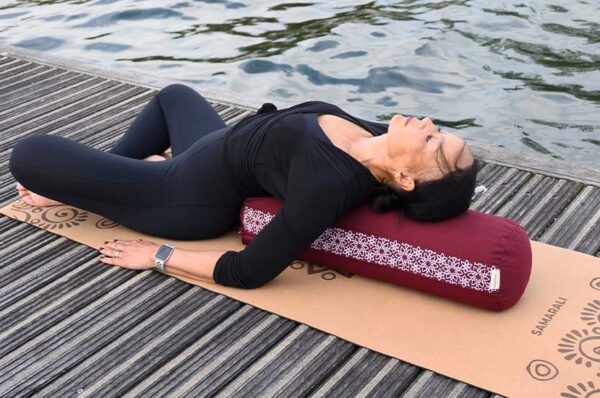
Use a yoga bolster for back pain in Vinyasa yoga during restorative poses, passive backbends, and the cool-down phase of your practice. A bolster supports the spine in a gentle, extended position without requiring muscular effort, which allows the back muscles to decompress and release tension accumulated during active sequences.
In a Vinyasa class, the bolster is most useful at the end of practice. Poses like Supported Fish, Reclined Bound Angle, or a gentle Supported Backbend over the bolster counteract the forward-folding and rounding that can build up during a dynamic flow. Placing the bolster lengthwise along the spine in a reclined position opens the chest and gently tractions the thoracic spine, which is a common area of tightness for people who sit at desks.
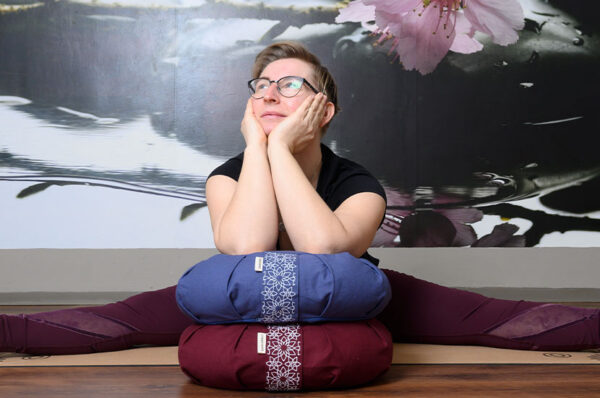
Our yoga bolster is designed with this kind of supportive use in mind, offering firm yet comfortable cushioning that holds its shape under body weight. If your back pain is concentrated in the lower lumbar region, try placing the bolster horizontally under your knees in Savasana instead. This small adjustment significantly reduces pressure on the lumbar curve.
Can a yoga strap improve alignment and reduce back strain?
Yes, a yoga strap directly improves alignment and reduces back strain by allowing you to maintain proper posture in poses where limited flexibility would otherwise cause compensatory rounding. In Vinyasa yoga, straps are particularly useful in seated forward folds, standing poses, and any movement where tight hamstrings or shoulders pull the spine out of neutral.
Tight hamstrings are one of the most common contributors to lower back pain in yoga. When the hamstrings cannot lengthen fully, the pelvis tilts backward, which flattens the lumbar curve and compresses the lower back. A strap looped around the feet in a seated forward fold lets you keep your spine long and your pelvis in a healthy anterior tilt, so the stretch moves into the legs rather than loading the back.
Straps are also useful for shoulder openers. In poses like Gomukhasana arms or a bound variation, reaching too far strains the upper back and neck. A strap bridges the gap between your hands, letting you work the shoulder mobility without torquing the thoracic spine.
As a general principle in Vinyasa yoga, the strap is your alignment tool and the block is your foundation tool. Used together with a quality mat from our yoga collection, these three props give you a complete support system for practicing safely with back pain, at any level of experience.
Ready to build a prop kit that genuinely supports your back? At Samarali, you will find everything you need for a safe and well-supported Vinyasa practice — from our yoga bolster designed for restorative spinal relief, to our natural rubber yoga mat that gives you a stable, non-slip foundation for every flow. Explore the full yoga collection and find the props that will help you practice smarter, move more freely, and keep your back feeling its best. Shop now.
Frequently Asked Questions
How do I know which prop to prioritize if I can only start with one?
If you can only invest in one prop, start with a set of yoga blocks. They address the most common cause of back pain in Vinyasa yoga — spinal rounding due to limited flexibility — and are versatile enough to support you in standing poses, forward folds, and transitions. Once your practice is consistent and you notice tightness persisting through seated or floor-based poses, add a strap next, followed by a bolster for cool-down and restorative work.
Can I use props in a fast-paced Vinyasa class without disrupting my flow?
Yes, with a little preparation you can integrate props seamlessly into a fast-paced flow. Set your blocks at their highest height at the front of your mat before class begins, and keep your strap loosely looped nearby so you are not searching for it mid-sequence. Over time, reaching for and adjusting props becomes second nature, and most experienced teachers actively encourage their use — using props is a sign of smart practice, not a limitation.
What are the most common mistakes people make when using props for back pain in yoga?
The most common mistake is using props at the wrong height or position, which can actually reinforce poor alignment rather than correct it. For example, placing blocks too low when flexibility is limited still forces the spine to round, defeating the purpose entirely. Another frequent error is abandoning props too soon — many practitioners remove them the moment a pose becomes slightly easier, rather than waiting until their alignment is genuinely stable and consistent without support.
Are there any Vinyasa poses where props should be avoided if I have back pain?
Rather than avoiding specific poses entirely, the focus should be on modifying them with props or skipping deep variations until your back is stronger and more stable. Deep unsupported backbends like full Wheel (Urdhva Dhanurasana) and extreme spinal twists are poses where forcing the range of motion without proper preparation can aggravate back pain significantly. In these cases, a bolster under the thoracic spine for a supported backbend or a block between the thighs in a twist are safer, more productive alternatives.
How do I know if my back pain during yoga is a sign I should stop practicing, or something props can help manage?
As a general guideline, a dull muscular ache or stiffness that improves as you warm up is typically the kind of discomfort that props, proper alignment, and gradual progression can address. Sharp, shooting, or radiating pain — especially any that travels down the leg — is a signal to stop immediately and consult a healthcare professional before continuing your practice. Props are supportive tools for functional discomfort and alignment challenges, not substitutes for medical evaluation when serious pain is present.
Do prop materials and quality actually matter, or will any block or strap work?
Material quality matters more than most beginners expect, particularly for blocks and bolsters. Foam blocks are lightweight and forgiving for beginners, but cork or wood blocks offer greater stability and are better suited for weight-bearing poses where a firm foundation is critical for spinal support. For bolsters, the firmness of the fill is key — a bolster that compresses too easily under body weight will not provide the consistent spinal support needed during restorative holds, so investing in a well-constructed option pays off over time.
Can using yoga props for back pain eventually help me practice without them?
Absolutely — this is actually the ideal outcome of consistent, prop-supported practice. Props allow you to practice with correct alignment repeatedly, and that repetition gradually builds the flexibility, strength, and body awareness needed to maintain good posture without external support. Think of props as a progressive training tool: as your hamstrings lengthen, your core strengthens, and your spinal awareness improves, you will naturally find yourself needing less support, though many experienced practitioners continue using props strategically even at advanced levels.