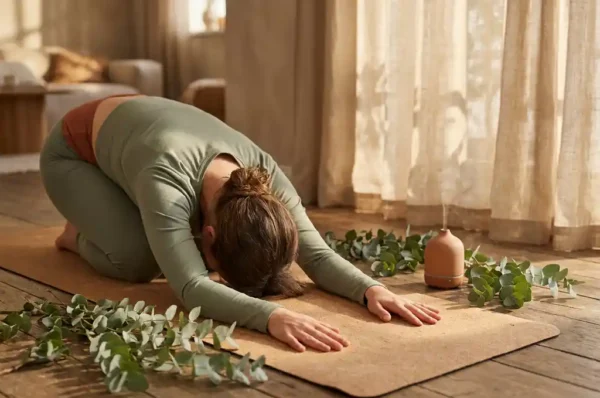



Yes, Vinyasa yoga can genuinely improve your posture. The practice builds strength and flexibility in the muscles that hold your spine upright, while the flowing sequence of poses trains your body to move with greater alignment and body awareness. Below, we break down exactly how it works and what to expect.
Which muscles does Vinyasa yoga target for better posture?
Vinyasa yoga targets the core, back extensors, glutes, and shoulder stabilizers — the four muscle groups most responsible for upright, balanced posture. By moving through continuous, breath-linked sequences, Vinyasa activates these muscles in coordinated patterns rather than in isolation, which is closer to how your body functions in everyday life.
The core is arguably the most important area. Poses like Plank, Chaturanga, and Boat strengthen the deep abdominal muscles that support the lumbar spine. A stronger core reduces the tendency to slump forward or overarch the lower back, both of which are common contributors to poor posture.
The upper and mid back also receive significant attention. Poses such as Cobra, Upward Dog, and Warrior III activate the erector spinae and rhomboids, the muscles that draw the shoulder blades together and keep the thoracic spine from rounding. For anyone who spends long hours at a desk, this is particularly valuable.
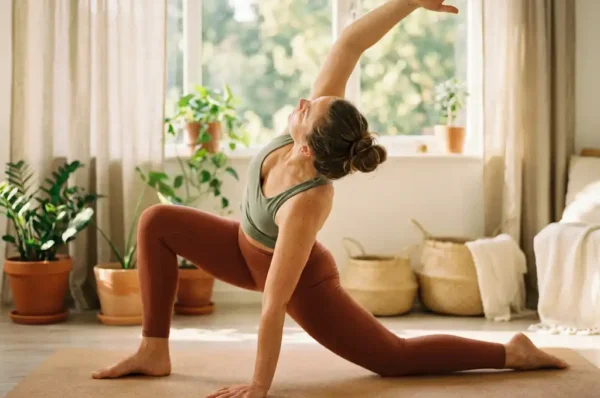
Hip flexors and glutes play a supporting role that often goes unnoticed. Tight hip flexors pull the pelvis forward, creating an anterior tilt that distorts the entire spinal curve. Vinyasa sequences regularly include low lunges, Crescent Pose, and Bridge, which stretch the hip flexors while simultaneously strengthening the glutes to restore a neutral pelvis. A well-aligned pelvis is the foundation of good posture from the ground up.
How does Vinyasa yoga correct common posture problems?
Vinyasa yoga corrects common posture problems by combining targeted strengthening with mobility work and real-time body awareness. Unlike passive stretching or isolated gym exercises, the flowing nature of Vinyasa trains your nervous system to recognize and maintain better alignment during movement, not just while standing still.
Forward head posture and rounded shoulders
Forward head posture and rounded shoulders are among the most widespread postural issues today, largely driven by screen time. Vinyasa addresses this through backbends and chest-opening poses like Camel, Wheel, and Thread the Needle, which stretch the pectorals and anterior shoulder muscles that pull the chest inward. At the same time, poses requiring you to draw the shoulder blades down and back retrain the postural muscles of the upper back to hold that open position habitually.
Lower back curvature and pelvic tilt
Excessive lower back curvature, often caused by anterior pelvic tilt, is corrected through the combination of hip flexor stretching and glute activation built into most Vinyasa flows. Poses like Warrior I and II also develop hip stability and teach the pelvis to sit in a neutral position, which directly reduces lower back strain. Over time, this correction becomes the body’s default resting alignment rather than something you consciously hold.
How long does it take for Vinyasa yoga to improve posture?
Most practitioners notice early postural improvements within four to eight weeks of consistent Vinyasa practice, typically two to three sessions per week. Deeper structural changes, such as lasting changes to muscle length and spinal alignment, generally take three to six months of regular practice to become habitual.
The timeline depends on a few key factors. The severity of existing postural imbalances matters — someone with mild rounding will see results faster than someone with long-standing structural tension. Consistency is more important than session length; three shorter practices per week outperform one long session for building the neuromuscular habits that underpin good posture.
Lifestyle factors also influence how quickly results appear. If you sit for eight or more hours a day, Vinyasa will work against that strain but may progress more slowly than for someone with a more movement-rich daily routine. Pairing your practice with small postural habits, such as standing up regularly and adjusting your workstation, accelerates the process considerably.
Practicing on a supportive, non-slip surface helps you focus entirely on alignment rather than stability. Our natural rubber yoga mat provides the grip and cushioning that makes precise postural work easier, especially in standing balance poses where alignment really matters.
Is Vinyasa yoga better for posture than other yoga styles?
Vinyasa yoga is particularly effective for posture because it builds both strength and flexibility simultaneously through dynamic movement, whereas slower styles like Yin or Restorative yoga primarily address flexibility and tension release. However, Vinyasa is not categorically better than all other styles — it depends on the specific postural issue being addressed.
Compared to Hatha yoga, Vinyasa offers more cardiovascular engagement and trains postural muscles under the mild fatigue of a flowing sequence, which can build greater functional strength. Hatha, with its longer held poses, may allow more time to explore precise alignment in individual postures, which is valuable for beginners learning the basics.
Iyengar yoga, known for its detailed alignment focus and use of props, rivals Vinyasa in postural correction and may even surpass it for people with significant structural imbalances who need very precise adjustments. If postural correction is your primary goal and you are working with a specific issue like scoliosis or chronic back pain, Iyengar or a therapeutic yoga approach may be more targeted.
For most people seeking general postural improvement alongside overall fitness and flexibility, Vinyasa yoga strikes an excellent balance. Its dynamic nature keeps practitioners engaged, the full-body sequencing addresses multiple postural muscles in each session, and the breath-movement connection builds body awareness that carries over into daily life. Exploring our full range of yoga products can help you set up a practice environment that supports consistent, alignment-focused sessions from the very beginning.
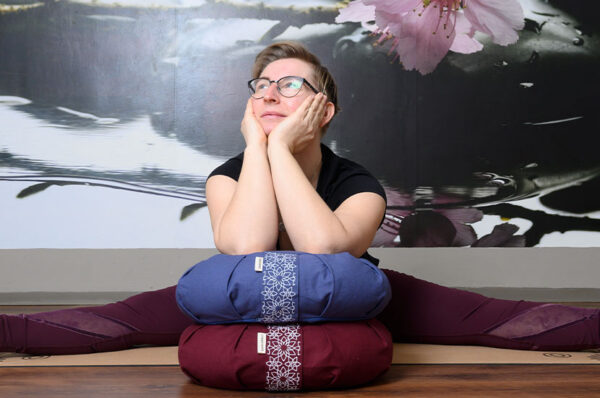
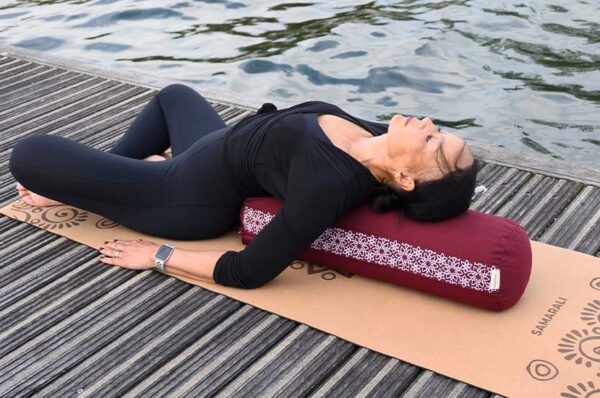
Ready to take your practice further? At Samarali, you’ll find everything you need to support a posture-focused Vinyasa routine. Whether you’re looking for a natural rubber yoga mat that keeps you grounded in every pose, a yoga bolster to deepen chest-opening stretches, or an organic cotton yoga blanket for added support and comfort, our collection is thoughtfully curated for practitioners who care about alignment and quality. Browse the full yoga collection at Samarali and find the tools that help you stand a little taller — on and off the mat. Shop now.
Frequently Asked Questions
Can I practice Vinyasa yoga for posture improvement if I'm a complete beginner?
Absolutely — beginners can start Vinyasa yoga for posture benefits right away, though it’s wise to begin with a beginner-level or slow-flow class that emphasizes alignment cues over speed. Many studios and online platforms offer foundational Vinyasa courses specifically designed to teach proper form before building pace. Starting slowly allows you to develop the body awareness that makes postural correction possible, rather than rushing through sequences without internalizing the alignment principles.
How many times per week should I practice Vinyasa yoga to see real posture improvements?
Two to three sessions per week is the sweet spot for most people looking to improve posture — frequent enough to build neuromuscular habits, but with enough recovery time to prevent fatigue-related form breakdown. Even 30-minute sessions at this frequency are more effective than a single long weekend class, because posture improvement relies on consistent repetition of correct movement patterns. If your schedule is tight, supplementing one full Vinyasa session with shorter targeted flows focusing on the spine, hips, and shoulders can help maintain momentum.
What if my posture gets worse or I feel more back pain after starting Vinyasa yoga?
Some mild muscle soreness in the back and core is normal in the first one to two weeks as previously underused postural muscles are activated, but sharp, persistent, or worsening pain is a signal to stop and reassess. The most common culprits are overarching the lower back in poses like Cobra or Upward Dog, and collapsing through the shoulders in Chaturanga — both of which place strain on the spine rather than correcting it. Working with a qualified yoga teacher, even for just a few sessions, can help you identify and correct these technical issues before they become a problem.
Are there specific Vinyasa poses I should prioritize if my main issue is tech neck and upper back rounding?
Yes — for forward head posture and upper back rounding, prioritize chest-opening backbends like Camel, Sphinx, and Puppy Pose, along with shoulder-strengthening poses such as Dolphin, Locust, and any variation of Warrior III. Incorporating Thread the Needle regularly will help release the thoracic rotation restrictions that often accompany rounded shoulders. Equally important is consciously practicing the ‘shoulder blades down and back’ cue in every pose, as this trains the rhomboids and lower trapezius to hold the upper back open habitually.
Can Vinyasa yoga replace physical therapy for posture correction?
Vinyasa yoga is a powerful complementary tool for posture correction, but it is not a replacement for physical therapy when a structural or clinical issue is involved — such as scoliosis, herniated discs, or chronic pain with a diagnosed cause. For general postural imbalances without an underlying medical condition, consistent Vinyasa practice can absolutely deliver meaningful, lasting results on its own. If you are unsure whether your posture issues have a clinical component, it’s worth getting a professional assessment before relying solely on yoga as your corrective strategy.
Does what I do outside of yoga class affect how quickly my posture improves?
Significantly — your posture during the other 22 or more hours of the day has a far greater cumulative impact than your time on the mat. Sitting with a collapsed spine for eight hours largely offsets the alignment work done in a one-hour Vinyasa session, which is why pairing your practice with simple daily habits makes a dramatic difference. Small changes like setting a timer to stand and move every 45 minutes, adjusting your monitor to eye level, and doing a few shoulder rolls and hip flexor stretches throughout the day will accelerate your progress considerably.
Is there a difference in posture benefits between in-person Vinyasa classes and practicing at home?
Both formats can deliver excellent posture benefits, but in-person classes offer the advantage of real-time alignment corrections from an instructor — something that is especially valuable in the early stages of practice when movement habits are still being formed. Home practice gives you flexibility and consistency, which are equally important for long-term postural change. A practical middle ground is to attend in-person or live online classes regularly to get feedback on your form, then use recorded home sessions to maintain frequency between those guided practices.