


Yin yoga is genuinely good for joints and connective tissue. Unlike more dynamic styles of yoga, yin yoga uses long, passive holds that apply gentle, sustained stress to the deeper layers of the body, including fascia, ligaments, and joint capsules. This makes it one of the most targeted practices for improving joint mobility and supporting connective tissue health. Below, we unpack exactly how it works, who it helps, and how to get started.
How does yin yoga actually affect connective tissue?
Yin yoga affects connective tissue by applying slow, sustained stress to the fascial network, ligaments, and joint capsules over extended holds of two to five minutes or longer. This prolonged loading encourages the remodeling and hydration of connective tissue, improving its elasticity and range of motion in ways that faster movement practices simply cannot match.
Most forms of exercise target muscle tissue, which responds relatively quickly to load and releases just as fast. Connective tissue is denser and less vascular, meaning it receives less blood flow and adapts more slowly. To stimulate a meaningful response in this tissue, you need gentle but sustained pressure, which is precisely what yin yoga delivers.
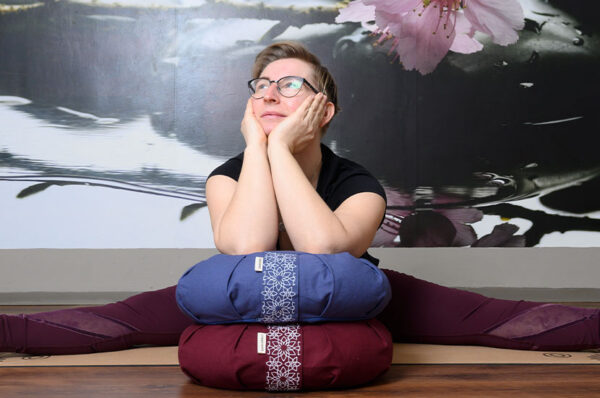
During a yin hold, the muscles gradually relax and the deeper structures begin to receive the stretch. Fascia, in particular, responds to this kind of loading by becoming more pliable over time. Practitioners often notice improved flexibility not just in the muscles but in areas like the hips, lower back, and inner thighs, which are regions where fascial density tends to accumulate. Pairing your practice with supportive props can make a real difference here. A yoga bolster helps you settle into deep holds without muscular strain, allowing the connective tissue to release at its own pace.
Is yin yoga safe for people with joint problems?
Yin yoga is generally safe for people with joint problems when practiced mindfully and with appropriate modifications. Because it avoids forceful or repetitive movement, it places far less mechanical stress on joints than high-impact exercise. For many people with chronic joint discomfort, yin yoga offers a gentle way to maintain mobility without aggravating existing conditions.
That said, not every yin pose suits every body, and joint conditions vary enormously. Someone with hypermobility, for example, needs to be cautious about going too deep into a stretch, since their joints may already move beyond a healthy range. Someone recovering from a joint injury should work with a qualified teacher and, where relevant, a physiotherapist before beginning a regular yin practice.
The key principle in yin yoga is finding your appropriate edge, a place of mild, manageable sensation rather than sharp or intense discomfort. Pain is always a signal to back off. With that awareness in place, yin yoga can actually be one of the most joint-friendly movement practices available, particularly for people who find more vigorous exercise too demanding.
What types of joint discomfort can yin yoga help with?
Yin yoga can help with joint discomfort related to stiffness, reduced range of motion, and fascial tightness around the hips, knees, lower back, and shoulders. It is particularly well suited to addressing the kind of chronic tightness that builds up from prolonged sitting, repetitive movement patterns, or general physical inactivity.
Hip and lower back stiffness
The hips and lower back are among the most common areas where people carry chronic tension. Yin poses like Dragon, Butterfly, and Sleeping Swan target the hip flexors, hip rotators, and the connective tissue of the lumbar spine. Regular practice of these poses can reduce the sensation of tightness and improve the overall freedom of movement in this region.
Knee and shoulder mobility
The knees and shoulders are complex joints surrounded by dense connective tissue that benefits from gentle, sustained attention. Yin yoga poses that work around these joints, approached carefully and supported with props, can help maintain their full range of motion and reduce the stiffness that often accompanies a sedentary lifestyle or the natural process of aging.
It is worth noting that yin yoga is not a treatment for acute inflammation, arthritis flare-ups, or post-surgical recovery. In those cases, medical guidance should always come first. But for the everyday joint discomfort that many people experience as background tension or limited movement, yin yoga offers a practical and accessible path forward.
How often should you practice yin yoga to see joint benefits?
Practicing yin yoga two to three times per week is generally enough to begin noticing meaningful improvements in joint mobility and connective tissue flexibility. Connective tissue adapts more slowly than muscle, so consistency over weeks and months matters more than the intensity of any single session.
For beginners, even one session per week is a worthwhile starting point. The important thing is showing up regularly rather than pushing hard in occasional sessions. Over time, you can build toward more frequent practice as your body adapts and you develop a better sense of your own edge in each pose.
The length of individual sessions also matters. A 45 to 75 minute yin practice gives enough time to work through several major joint areas with holds of sufficient duration. Shorter sessions of 20 to 30 minutes can still be valuable, particularly when focused on a specific region like the hips or spine.
Creating a consistent home practice environment helps enormously. Having the right props available, such as a supportive mat and a yoga blanket for added comfort and warmth during long holds, makes it easier to settle in and stay with the practice. At Samarali, we design our yoga props with exactly this kind of slow, intentional practice in mind, so your body has everything it needs to release fully and safely.
Frequently Asked Questions
Can I do yin yoga if I'm a complete beginner with no yoga experience?
Absolutely. Yin yoga is one of the most beginner-friendly styles of yoga precisely because it is slow, passive, and does not require strength, balance, or prior flexibility. Starting with a beginner-focused class or guided video is a great entry point, and using props like bolsters, blocks, and blankets will help you find comfortable positions without straining. The most important skill to develop early on is simply learning to distinguish between productive sensation and pain — a distinction that becomes more intuitive with each session.
What is the difference between yin yoga and restorative yoga, and which is better for joints?
Yin yoga and restorative yoga are both slow, floor-based practices, but they serve different purposes. Restorative yoga uses extensive prop support to bring the body into a fully relaxed, neutral state with no intentional stress on the tissues — it is primarily about rest and nervous system recovery. Yin yoga, by contrast, intentionally applies mild, sustained stress to connective tissue and joint capsules to stimulate adaptation and improve mobility. For joint health and increasing range of motion specifically, yin yoga is the more targeted choice, while restorative yoga is better suited to recovery and deep relaxation.
How do I know if I'm holding a yin pose correctly, or if I'm going too deep?
The guiding principle in yin yoga is finding your ‘appropriate edge’ — a place where you feel a noticeable but manageable sensation, often described as mild intensity rather than sharp, burning, or shooting discomfort. If you feel pain, numbness, tingling in the joints, or a sense of compression rather than stretch, that is a clear signal to ease out of the pose or use more prop support. A useful rule of thumb is that you should be able to breathe slowly and relatively comfortably throughout the hold; if your breath becomes forced or shallow, you have likely gone too far.
Should I do yin yoga before or after more active exercise?
It is generally better to practice yin yoga after more active exercise, or as a standalone session, rather than immediately before dynamic or strength-based activity. Deep yin holds temporarily reduce the stiffness in connective tissue and may slightly decrease joint stability in the short term, which is not ideal right before high-intensity movement. Practicing yin after an active session, however, is an excellent way to cool down, address accumulated tension, and support recovery. If you want to practice yin on the same day as vigorous exercise, leaving a gap of at least a few hours between the two is a sensible approach.
Are there any conditions where yin yoga should be avoided entirely?
While yin yoga is broadly accessible, there are situations where it should be approached with significant caution or temporarily avoided. These include acute joint injuries or inflammation, recent surgery on joints or connective tissue, diagnosed hypermobility conditions such as Ehlers-Danlos Syndrome, and active arthritis flare-ups. Pregnancy also warrants modifications, particularly in poses that compress the abdomen or place stress on the sacroiliac joint. In any of these cases, consulting a physiotherapist or doctor before starting a yin practice is strongly recommended, and working with an experienced teacher who can offer personalised modifications is invaluable.
Why do I sometimes feel more stiff or sore the day after a yin yoga session?
Mild post-practice soreness after yin yoga is relatively common, especially in the early weeks, and is generally a sign that tissues which have not been loaded in this way before are beginning to adapt. Because yin yoga reaches deeper layers of connective tissue that most other movement practices do not target, the body can respond with a temporary feeling of achiness or sensitivity — similar to the delayed muscle soreness experienced after a new form of exercise. This typically eases as your practice becomes more regular. However, if the soreness is sharp, concentrated in a joint rather than the surrounding tissue, or persists for more than a day or two, it is worth reviewing your depth in poses and, if needed, seeking guidance from a qualified yin yoga teacher.
What props do I actually need to start a home yin yoga practice?
You can begin a home yin yoga practice with very minimal equipment, but a few key props make a significant difference in both comfort and effectiveness. A good-quality, non-slip yoga mat is the essential foundation. A yoga bolster is arguably the most versatile yin prop, supporting the body in deep hip and spine poses so muscles can fully release. A yoga blanket adds warmth during long holds — important because body temperature drops during stillness — and can also be folded for extra cushioning under knees or hips. Yoga blocks are useful for adjusting height in seated and reclined poses. Starting with even one or two of these props will meaningfully improve your ability to hold poses for the full duration and get the most from each session.
Ready to support your yin yoga practice with the right props? At Samarali, you will find everything you need to practice with ease and intention. Whether you are looking for a yoga bolster to ease into deep hip and spine holds, an organic cotton yoga blanket to stay warm during long, still holds, or a natural rubber yoga mat as a grounded foundation for your practice, our collection is designed with slow, mindful movement in mind. Explore the full yoga collection at Samarali and give your body the support it deserves — shop now.