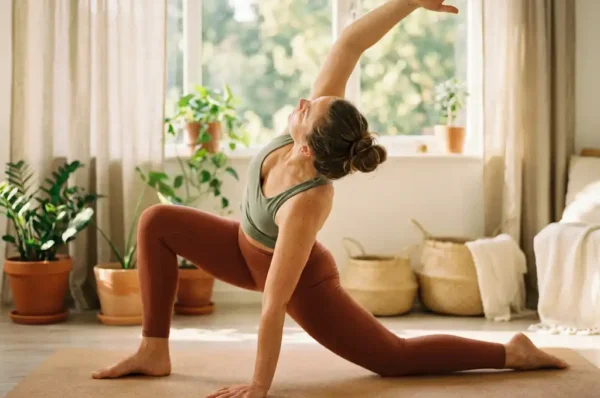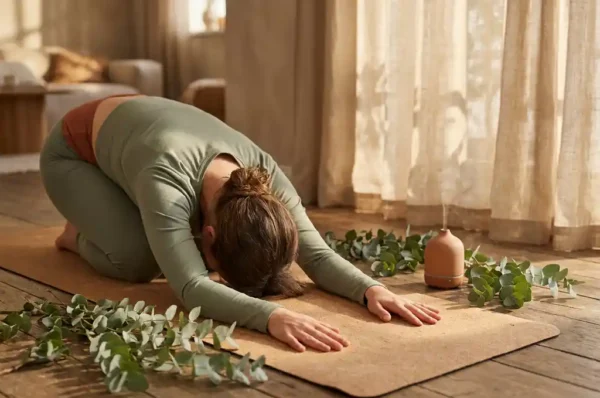



To create a calming environment for Yoga Nidra, focus on minimizing sensory distractions while maximizing physical comfort. The practice involves lying completely still in a state of conscious relaxation, so your surroundings need to support stillness rather than stimulate the mind. Below, we answer the most common setup questions to help you build a space that genuinely works.
What elements make a space ideal for Yoga Nidra?
An ideal Yoga Nidra space is warm, quiet, dimly lit, and free from interruptions. Because the practice asks you to stay motionless for an extended period, the environment needs to remove any reason for your body or mind to resist settling. Temperature, clutter, scent, and sound all play a role in how quickly you drop into that deep, receptive state.
Start with temperature. A room that feels comfortable when you are active will feel noticeably cooler once you lie still for twenty or thirty minutes. Slightly warmer than your usual preference is a good baseline, and having a blanket within reach lets you fine-tune it without interrupting the session.
Clutter and visual noise matter more than most people expect. Even with your eyes closed, walking into a messy or chaotic space raises mental alertness. A tidy, intentionally arranged area signals to the nervous system that this is a place for rest. You do not need a dedicated studio to achieve this effect. A cleared corner of a bedroom or living room works just as well when it is consistently used for practice.
Some practitioners find that a light, natural scent, such as lavender or sandalwood, helps anchor the transition from daily activity into practice. Keep any fragrance subtle. Overpowering scents can become a distraction rather than a support.
How do you control sound and lighting for Yoga Nidra?
For sound, aim for either complete quiet or a consistent, neutral background sound like soft ambient music or gentle white noise. For lighting, dim or eliminate all direct light sources so the room feels soft and enclosed without being completely dark. Both adjustments reduce external stimulation so the mind can turn inward.
Managing sound
Sudden or unpredictable sounds are the biggest disruptors during Yoga Nidra because they trigger the startle response and pull you out of the hypnagogic state the practice cultivates. If your environment is noisy, low-volume ambient sound or nature recordings can mask irregular sounds without adding mental content. Avoid music with lyrics or strong melodic hooks, as the mind tends to follow them rather than release into stillness. If you are using a guided recording, make sure the volume is low enough to feel like an internal voice rather than an external instruction.
Managing lighting
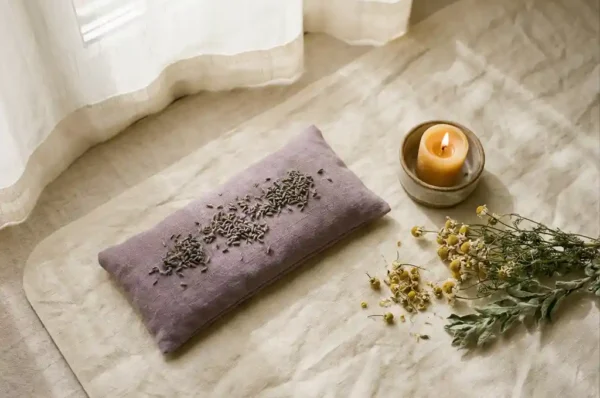
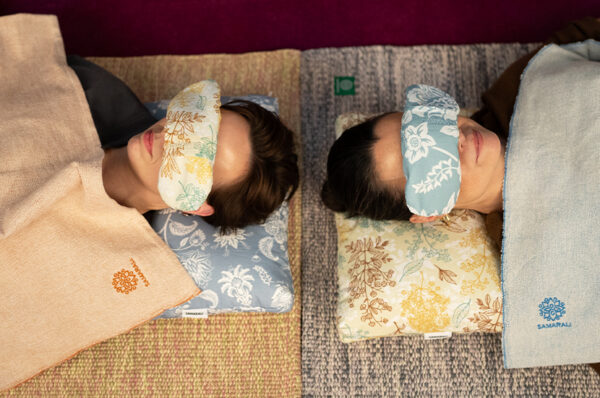
The goal is to reduce light enough that your eyelids feel heavy and relaxed rather than filtering brightness. Blackout curtains are the most effective solution for daytime practice. In the evening, switching off overhead lights and using a single low lamp in the corner of the room creates a soft, enveloping atmosphere. An eye pillow is one of the simplest and most effective tools available. It blocks residual light completely and adds a gentle, grounding weight that encourages the eyes to stay closed naturally.
What props and comfort items support a calming Yoga Nidra setup?
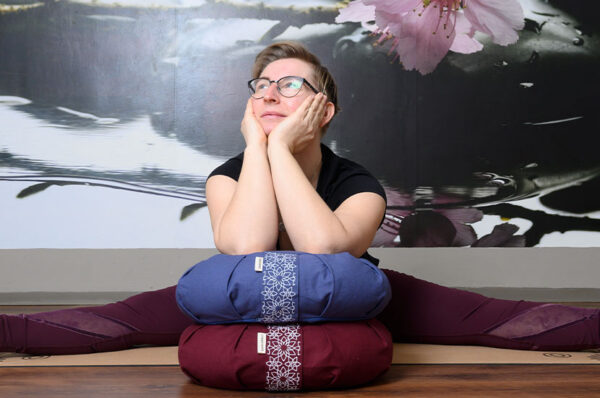
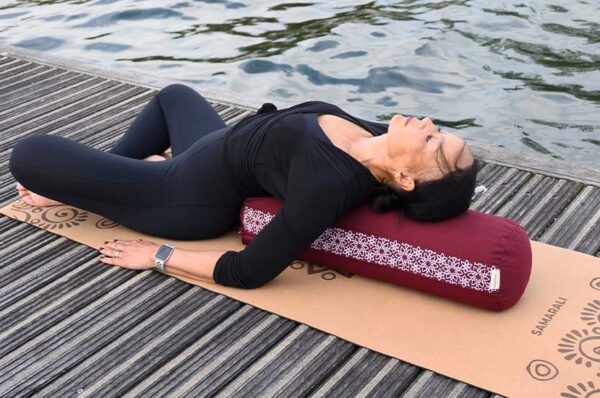
The core props for Yoga Nidra are a supportive mat or blanket to lie on, a bolster or rolled blanket under the knees, a blanket for warmth, and something to support the head and neck. These items collectively allow the body to release muscular tension completely, which is the physical prerequisite for entering the deeper layers of the practice.
A quality mat provides the foundational layer. Our organic cotton yoga blanket works beautifully both as an additional cushioning layer and as a cover to keep you warm once your body temperature drops during stillness.
Placing a bolster or a folded blanket beneath the knees takes pressure off the lower back and allows the legs to soften fully. This single adjustment makes a significant difference for anyone who finds it difficult to lie flat for extended periods. A yoga bolster is particularly useful here because its firm, consistent support prevents the knees from rolling inward during a long session.
For the head and neck, a thin, flat support works better than a thick pillow. You want the cervical spine to remain in a neutral position rather than being pushed forward. A folded blanket or a dedicated yoga neck pillow achieves this without the over-elevation that a standard sleeping pillow creates.
An eye pillow, as mentioned above, completes the setup. The combination of darkness and gentle pressure on the closed eyes activates the oculocardiac reflex, which naturally slows the heart rate and deepens relaxation.
Can you practice Yoga Nidra outside a dedicated yoga room?
Yes, you can practice Yoga Nidra in any space where you can lie down undisturbed and control basic sensory conditions. A dedicated room is helpful but not necessary. What matters is consistency and intention, not the physical designation of the space.
Many practitioners use a bedroom, a quiet living room, or even an outdoor space on a warm, sheltered day. The key is to prepare the environment before you begin rather than adapting mid-practice. Draw the curtains, set your phone to silent, arrange your props, and adjust the temperature before you lie down. This preparation ritual itself becomes part of the transition into the practice.
Outdoors, natural sounds like birdsong or wind are generally compatible with Yoga Nidra because they are consistent and non-intrusive. Traffic, voices, or construction noise are less ideal. If you practice outside regularly, choosing a sheltered spot and a time of day when ambient noise is low makes a meaningful difference.
The most important factor is not the room but the habit. Returning to the same space and the same setup each time trains your nervous system to associate that environment with deep rest. Over time, simply lying down in your prepared space can begin to shift your state before the practice even starts.
Ready to create your ideal Yoga Nidra setup? At Samarali, you will find everything you need to build a space that truly supports deep rest. From our yoga bolster and organic cotton yoga blanket to our dedicated meditation mat and yoga neck pillow, each piece is chosen to help your body settle fully and your mind let go. Explore the full meditation sets collection and find the combination that works for you — shop now.
Frequently Asked Questions
How long should a Yoga Nidra session be, and does the setup need to change for shorter or longer practices?
A typical Yoga Nidra session runs anywhere from 20 to 45 minutes, though some practices extend to an hour. For shorter sessions, your setup can remain largely the same, but for longer practices, pay extra attention to warmth and knee support, since body temperature drops more significantly and joint discomfort becomes more noticeable the longer you remain still. Having an extra blanket within arm’s reach before you begin is always a good precaution.
What should I do if I keep falling asleep during Yoga Nidra instead of staying in that in-between state?
Falling asleep occasionally is normal, especially in the early stages of practice or when you are sleep-deprived, but if it happens consistently, a few adjustments can help. Try practicing at a time of day when you are naturally more alert, such as mid-morning rather than just before bed, and slightly reduce the warmth in the room. Keeping your arms a few centimeters away from your body rather than resting them directly against it can also maintain just enough subtle body awareness to prevent full sleep onset.
Is it okay to use a phone or tablet to play a guided Yoga Nidra recording, and how should I manage notifications?
Using a phone or tablet is completely fine and is how most people access guided sessions. The critical step is enabling Do Not Disturb mode and turning off all non-essential notifications before you lie down, since even a single buzz or chime can instantly break the hypnagogic state you are working to enter. Place the device face-down or out of your line of sight, and if possible, pre-load the recording so you do not need to interact with the screen once you are settled.
How do I set up a Yoga Nidra space in a small apartment where I don't have a separate room to dedicate to practice?
A dedicated room is not required — a consistently prepared corner of any room works just as effectively. Choose a spot where you can fully lie down without rearranging furniture each time, keep your props stored nearby so setup takes under two minutes, and use a specific cue like dimming a lamp or rolling out your mat to signal the start of practice to your nervous system. Over time, that small, intentional corner will carry the same psychological weight as a full studio space.
Can children or beginners with no yoga background practice Yoga Nidra using the same setup guidelines?
Yes, Yoga Nidra is one of the most accessible yoga practices precisely because it requires no physical movement or prior experience. Beginners and children can follow the same setup principles, though shorter session lengths of 10 to 20 minutes are more appropriate for younger practitioners or complete newcomers. For children, a slightly more familiar environment with a beloved blanket or stuffed animal nearby can ease the transition into stillness without disrupting the core conditions the practice needs.
Are there any common setup mistakes that prevent people from getting the most out of Yoga Nidra?
The most common mistake is underestimating temperature — most people set the room too cool, then spend the first half of the session distracted by mild discomfort rather than relaxing into the practice. A close second is skipping the preparation ritual and lying down in a space that hasn’t been intentionally arranged, which keeps the nervous system in a mild state of alertness. Finally, using music with lyrics or a guided recording at too high a volume are frequent audio errors that give the mind something to engage with rather than something to release into.
How do I know if my props are positioned correctly before I start a session?
A simple pre-practice body scan before beginning the guided session is the most reliable check. Lie down in your intended position and notice whether your lower back feels any strain — if it does, add more height under your knees. Check that your neck feels long and neutral rather than pushed forward or tilted back, and confirm that your shoulders are resting evenly without tension. If you find yourself wanting to shift or adjust within the first two minutes, make those corrections immediately, as unresolved physical discomfort will surface and distract you throughout the entire session.