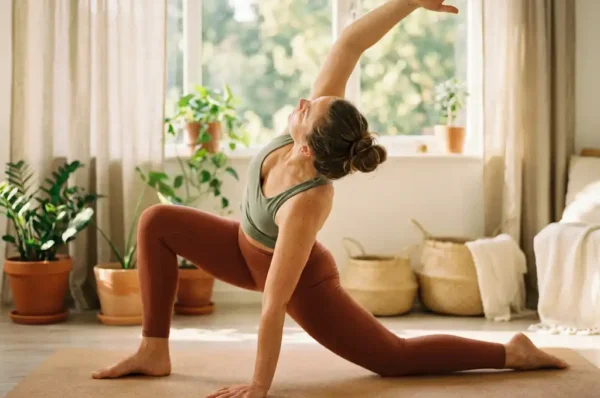



For Vinyasa yoga, a low to medium support sports bra is the right choice. Vinyasa is a flowing, dynamic style that involves constant movement and transitions, but it does not involve the high-impact bouncing of running or HIIT. That means you need a bra that moves with you, stays comfortable through deep stretches, and keeps you covered during inversions and forward folds. Below, we break down exactly what to look for.
What support level does Vinyasa yoga actually need in a sports bra?
Vinyasa yoga requires low to medium support in a sports bra. The practice is movement-rich and continuous, but the motion is fluid rather than high-impact. You are transitioning between poses, flowing through sun salutations, and holding challenging positions, all of which demand freedom of movement more than heavy-duty compression.
High-support sports bras, the kind designed for running or jumping, tend to be heavily structured with thick straps and firm underwiring. While they offer excellent hold, they can restrict your range of motion, dig into your ribs during deep breathing, and feel suffocating in a heated Vinyasa class. A medium-support bra gives you enough hold to feel secure without limiting how freely your body can move.
For smaller cup sizes, a light-support yoga bra often provides everything you need. For larger cup sizes, leaning toward the medium end of the support spectrum makes more sense, particularly for faster-paced flows where you want a little more stability during transitions.
What features should a Vinyasa yoga sports bra have?
The best sports bra for Vinyasa yoga should combine breathability, a full range of motion, moisture-wicking fabric, and a secure but non-restrictive fit. Because Vinyasa is a continuous, breath-linked practice, the bra needs to support your body without interfering with your breath or your movement.
- Breathable, moisture-wicking fabric: Vinyasa classes, especially heated ones, generate real sweat. Look for fabrics that pull moisture away from your skin and allow airflow.
- Wide, stable straps: Thin spaghetti straps can slip during inversions or downward dog. Wider straps stay in place and distribute weight more evenly.
- A secure underband: The band should sit firmly without digging in. During twists and side stretches, a band that rides up or digs into your ribs becomes a real distraction.
- Full coverage or a racerback cut: Racerback designs open up the shoulder blades and allow freer arm movement, which is ideal for poses like warrior sequences and chaturanga.
- Flat or minimal seams: Raised seams can cause irritation during extended practice, particularly against the skin in warm conditions.
If sustainability matters to you in your practice, look for bras made from organic cotton, recycled materials, or other certified eco-friendly fabrics. At Samarali, we design our yoga sets with exactly this kind of mindful construction in mind, pairing breathable, ethical materials with functional design for the modern practitioner.
What’s the difference between a yoga bra and a regular sports bra for Vinyasa?
A yoga bra is specifically designed for the range of motion, breath capacity, and sustained wear that yoga demands, while a regular sports bra is built primarily to minimize bounce during high-impact activity. For Vinyasa yoga, this difference matters more than most people expect.
Regular sports bras often use heavy compression to keep everything in place during running or aerobics. That compression can work against you in a Vinyasa class by restricting your ability to take deep, full breaths, which is central to the practice. Tight chest compression also makes poses like wheel, fish, or camel genuinely uncomfortable.
Yoga bras, by contrast, tend to prioritize the following:
- Softer, more flexible fabric construction that expands with your breath
- Designs that stay put during inversions without relying on rigid structure
- Aesthetic details like open backs or strappy designs that complement yoga attire
- Lighter weight and less bulk so the bra disappears into your practice
That said, not every product labeled a “yoga bra” is ideal, and not every sports bra is unsuitable. The key is to assess the specific features rather than relying on marketing labels. Try it on, take a deep breath, and reach your arms overhead. If the bra restricts either movement, it is not the right fit for Vinyasa.
Should you choose a padded or non-padded sports bra for Vinyasa yoga?
For Vinyasa yoga, a lightly padded or non-padded sports bra is generally the better choice. Removable padding gives you flexibility, while built-in thick padding can shift during dynamic movement and add unnecessary heat in a flowing practice.
Light removable pads offer the best of both worlds. You can wear them when you want coverage and remove them when you prefer a lighter, cooler feel, which is especially useful during hot yoga or heated Vinyasa sessions. Fixed thick padding, on the other hand, tends to bunch, fold, or shift when you move through transitions quickly, which can be distracting mid-flow.
Non-padded bras work well for practitioners who prioritize breathability and minimal fabric against the skin. They are typically lighter, dry faster, and feel less restrictive through the full range of Vinyasa movement. If coverage is a concern, opting for a thicker, higher-quality fabric can provide modesty without the bulk of added padding.
Ultimately, the right choice depends on your personal preference and the intensity of your practice. What matters most is that the bra stays in place, breathes well, and lets you move freely from the first sun salutation to the final savasana. Pairing the right bra with the rest of your yoga setup, from your mat to your accessories, makes a genuine difference in how comfortable and focused your practice feels.
Ready to complete your Vinyasa practice from the mat up? At Samarali, you will find everything you need to support a mindful, comfortable flow. Roll out a natural rubber yoga mat that grips through every transition, wrap up in an organic cotton yoga blanket for savasana, or carry it all in style with a yoga mat bag. Browse the full yoga sets collection and find the pieces that make your practice feel as good as it looks. Shop now.
Frequently Asked Questions
How do I know if my sports bra fits correctly for Vinyasa yoga before committing to a full class?
Do a quick at-home fit test before your first class: put the bra on, take three deep belly breaths, raise both arms overhead, fold forward, and simulate a downward dog position. If the band rides up, the straps dig in, or you feel restricted taking a full breath at any point, the bra is not the right fit for Vinyasa. The bra should feel secure but almost unnoticeable throughout all of these movements.
Can I wear the same sports bra for Vinyasa yoga and running, or do I really need separate ones?
Technically you can, but it is not ideal for either activity. A high-support running bra will restrict your breath and range of motion in Vinyasa, while a low-support yoga bra will not provide enough hold for the repetitive impact of running. If you practice both regularly, investing in purpose-specific bras for each activity will noticeably improve your comfort and performance in both.
What should I look for in a sports bra specifically for hot or heated Vinyasa classes?
For heated Vinyasa or hot yoga, prioritize ultra-lightweight, fast-drying fabrics with strong moisture-wicking properties, such as recycled nylon or performance polyester blends. Avoid thick padding, heavy compression bands, or fabrics that trap heat against the skin. A minimal, open-back or racerback design with flat seams will keep you cooler and reduce skin irritation when you are sweating heavily throughout the class.
How often should I replace my Vinyasa yoga sports bra, and what are the signs it needs replacing?
Most sports bras lose their functional support and elasticity after 6 to 12 months of regular use, or roughly 30 to 40 wash cycles. Key signs it is time to replace yours include a band that no longer stays snug, fabric that has stretched out and lost its shape, straps that slip constantly despite adjustment, or fabric that stays damp longer than it used to. Worn-out elastic not only reduces support but can also cause the bra to shift during inversions and transitions.
Are there specific sports bra styles to avoid for Vinyasa yoga, even if they are marketed as yoga bras?
Yes — avoid bras with underwire, as the rigid structure can dig into your ribs during deep twists and backbends. Strapless or bandeau-style bras are also a poor choice for Vinyasa since they rely on tight compression to stay up and tend to roll or slip during inversions. Similarly, bras with very thin, non-adjustable spaghetti straps can shift significantly during downward dog or arm balances, creating a constant distraction mid-practice.
Does cup size affect which type of Vinyasa yoga bra I should choose?
Yes, cup size plays an important role in finding the right support level. Practitioners with a smaller bust (typically A or B cup) often find that a light-support yoga bra provides all the hold they need with maximum freedom of movement. Those with a larger bust (C cup and above) will generally be more comfortable in a medium-support bra that offers wider straps, a more structured underband, and a higher neckline for added security during faster-paced flows and inversions.
How should I care for my Vinyasa yoga sports bra to make it last longer?
Always wash your sports bra in cold water on a gentle cycle, or hand wash it when possible, to preserve the elasticity of the fabric and straps. Avoid putting it in the dryer, as heat degrades elastic fibers quickly — air drying flat is the best method. Remove any removable pads before washing to prevent them from warping, and avoid using fabric softeners, which can clog moisture-wicking fibers and reduce the bra’s breathability over time.