


The most effective yoga props for back pain in Hatha Yoga are blocks, bolsters, straps, and blankets. These tools help you maintain proper spinal alignment, reduce muscular strain, and access poses safely without forcing your body into positions it is not ready for. Below, we break down exactly how each prop works and how to choose the right ones for your practice.
Which yoga props are most effective for back pain relief?
For back pain relief in Hatha Yoga, the four most effective props are yoga blocks, bolsters, straps, and blankets. Blocks support the spine in standing and seated poses, bolsters decompress the lower back in restorative positions, straps allow you to lengthen safely without rounding, and blankets provide cushioning under sensitive areas like the sacrum and knees.
Back pain in yoga most often comes from one of two sources: overreaching into a pose before the body is ready, or collapsing the spine due to tight hamstrings or hip flexors pulling on the lumbar region. Props interrupt both patterns by giving your body a stable surface to rest against, reducing the muscular effort required to hold a position.
In Hatha Yoga specifically, where poses are held for longer periods than in faster flow styles, props become even more valuable. Holding a poorly aligned posture for thirty seconds or more can reinforce strain rather than release it. A block under your hand in Triangle Pose, for example, keeps the torso long and the spine neutral instead of letting it twist unevenly under load.
- Yoga blocks are the most versatile prop for back pain, used in standing, seated, and supine poses
- Bolsters are ideal for restorative and yin-style Hatha sequences where passive release is the goal
- Straps help in forward folds and hip openers where tight hamstrings pull the lower back into flexion
- Blankets cushion the sacrum and tailbone in seated and reclined poses
How does a yoga block support the spine in Hatha poses?
A yoga block supports the spine by raising the floor to meet your hands, hips, or head, so your torso does not have to collapse or overextend to reach a surface. This keeps the spine in a neutral, elongated position during Hatha poses and removes the compressive load that causes or worsens back pain.
In standing poses like Triangle or Half Moon, placing a block under the lower hand prevents the upper body from crunching sideways. The spine stays long, the chest stays open, and the muscles along the back can work evenly rather than compensating for a reach they cannot yet manage.
In seated forward folds, sitting on a block or placing one under the knees tilts the pelvis forward slightly, which takes tension off the lumbar spine. Many people with tight hamstrings unconsciously round their lower back in Paschimottanasana, which loads the discs rather than stretching the posterior chain. A block under the sitting bones corrects that pattern immediately.
For supine poses like Bridge, a block placed under the sacrum transforms the pose into a gentle, passive backbend that decompresses the lumbar vertebrae rather than compressing them. This is one of the most commonly recommended modifications for people with lower back sensitivity in Hatha practice.
When should you use a bolster versus a strap in Hatha Yoga?
Use a bolster when the goal is passive release and spinal decompression, and use a strap when you need to extend your reach without rounding the spine. Bolsters are best in restorative or slower Hatha sequences where you hold poses for several breaths. Straps are best in active poses where flexibility limitations cause the back to compensate.
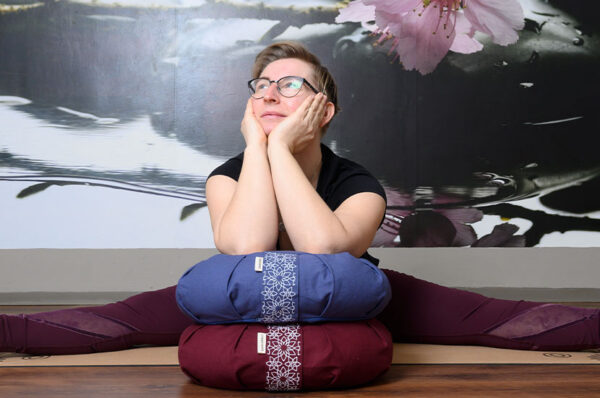
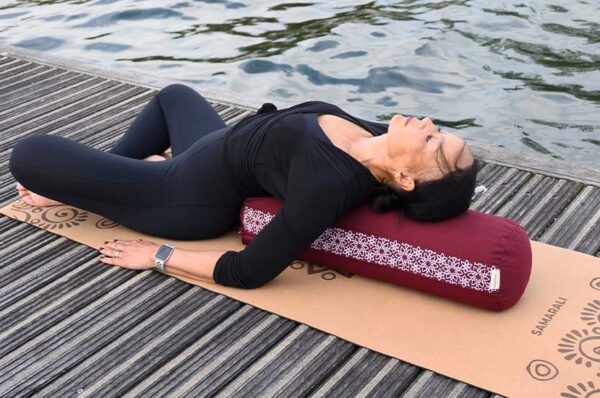
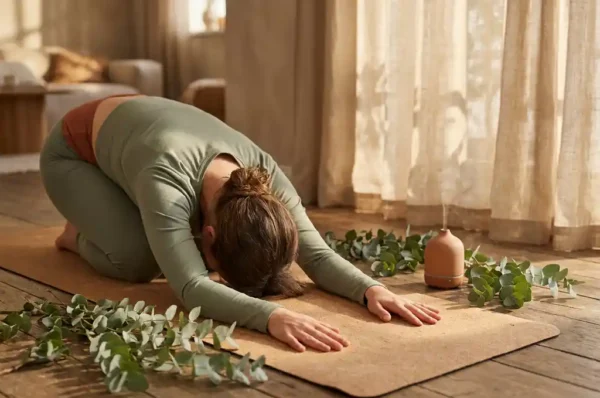
A yoga bolster works by supporting the weight of your body so your muscles can fully let go. In Supported Child’s Pose or Supta Baddha Konasana, the bolster placed lengthwise along the spine allows the back muscles to release tension they would otherwise have to maintain. This passive decompression is particularly helpful for people recovering from lower back fatigue or mild disc sensitivity.
A strap, on the other hand, is an active tool. In Seated Forward Fold, looping a strap around the feet allows you to maintain a straight spine and hinge from the hips rather than curling the lumbar region toward the shins. In Reclining Hand-to-Big-Toe Pose, a strap lets you keep the raised leg at a height your hamstrings can genuinely accommodate, preventing the pelvis from tilting and straining the sacroiliac joint.
A simple way to decide: if you want your muscles to soften and your nervous system to downregulate, reach for the bolster. If you want to maintain active length and correct alignment while building flexibility, reach for the strap.
What should you look for when choosing sustainable yoga props?
When choosing sustainable yoga props for back pain support, look for natural or recycled materials, transparent manufacturing practices, and durability. The most eco-conscious options include props made from organic cotton, natural rubber, buckwheat, or sustainably sourced cork, all of which are biodegradable or responsibly harvested and hold up well over years of regular use.
Material choice matters both environmentally and functionally. Synthetic foam blocks, for example, are inexpensive but break down over time and are not biodegradable. Cork blocks are firmer, more stable under weight, and made from renewable bark that does not require the tree to be cut down. For back pain support, that extra firmness is often an advantage.
For bolsters and blankets, organic cotton filling and covers are preferable to synthetic alternatives. Organic cotton is grown without harmful pesticides, is gentler on the skin, and holds its shape reliably. We design our yoga products with exactly these standards in mind, using natural materials that support both your practice and the planet.
Here are the key qualities to evaluate when shopping for sustainable Hatha yoga props:
- Material transparency: the brand should clearly state what the prop is made from and where
- Certifications: look for GOTS (organic textiles), FSC (wood or cork), or OEKO-TEX labels
- Durability: a prop that lasts five years has a lower environmental footprint than one replaced annually
- Functional density: for back pain specifically, firmer props like cork or solid cotton provide better structural support than soft synthetic alternatives
- Ethical manufacturing: European-made or fairly traded products reduce supply chain impact
Choosing props that meet these criteria means you are investing in tools that genuinely serve your back health over the long term, rather than products that degrade quickly and end up in landfills. In 2026, the range of high-quality, genuinely sustainable yoga props is wider than ever, making it easier to build a Hatha practice that is kind to your spine and to the environment at the same time.
Frequently Asked Questions
Can I use yoga props for back pain even if I'm a complete beginner?
Absolutely — in fact, props are even more essential for beginners than for experienced practitioners. When you’re new to Hatha Yoga, your body hasn’t yet developed the flexibility or body awareness to hold poses safely without support. Starting with blocks, a strap, or a bolster from day one helps you build correct movement patterns from the beginning, rather than developing compensations that can cause back pain later.
How many props do I actually need to get started with a back-pain-focused Hatha practice?
You can build a highly effective, back-supportive practice with just two props: a pair of yoga blocks and a strap. These two items cover the majority of standing, seated, and forward fold modifications that address back pain. A bolster and blanket are wonderful additions once you want to incorporate more restorative sequences, but they’re not essential in the beginning.
What if using props makes me feel like I'm 'cheating' or not progressing in my practice?
This is one of the most common misconceptions in yoga — props are not a shortcut or a sign of weakness; they are precision tools that allow your body to experience correct alignment, often for the very first time. Many advanced practitioners and experienced teachers use props in every single session because they make the pose more effective, not less. Think of them the way a musician thinks of a metronome: a tool that sharpens the quality of the practice, not a crutch that replaces skill.
Are there any Hatha Yoga poses I should avoid entirely if I have back pain, even with props?
Yes — certain poses carry a higher risk for people with active back pain and should be approached with caution or avoided until you’ve consulted a healthcare professional. Deep unsupported backbends like Full Wheel (Urdhva Dhanurasana), intense twists with a rounded spine, and any pose that causes sharp or shooting pain should be set aside. Props can modify many poses safely, but they are not a substitute for medical guidance when pain is acute, radiating, or accompanied by numbness.
How do I know if I'm using a prop correctly, or if I'm just making myself more comfortable without actually helping my spine?
The key indicator is spinal neutrality: after placing the prop, your spine should feel longer, your breath should deepen, and the muscular effort in your back should noticeably reduce. If you place a block under your hand but still feel your torso collapsing or twisting, the block may be at the wrong height — try adjusting it to a higher setting. A well-placed prop should create the sensation of space and ease in the spine, not just physical comfort in the limbs.
Can yoga props help with upper back and neck pain, or are they mainly useful for the lower back?
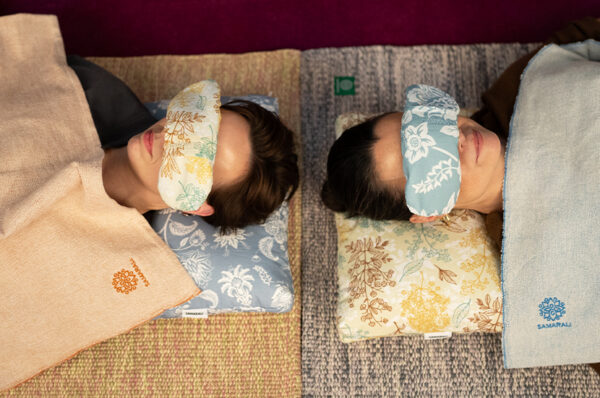
Props are highly effective for upper back and neck pain as well, though the specific tools and placements differ. A tightly rolled blanket placed under the thoracic spine in a supported recline can gently open the mid-back and counteract the forward rounding caused by prolonged sitting. A bolster under the head and neck in Savasana or Supta Baddha Konasana releases tension in the cervical spine. For neck pain specifically, never let the head drop unsupported — a folded blanket under the skull is a simple but important modification.
How do I care for and maintain natural-material props like cork blocks and organic cotton bolsters to make them last?
Cork blocks can be wiped down with a damp cloth and mild soap after practice and should be stored away from prolonged direct sunlight, which can dry out the material over time. Organic cotton bolsters and blankets typically have removable covers that can be machine-washed on a gentle cycle; the inner cushion should be aired out regularly to prevent moisture buildup and maintain its shape. Proper care of high-quality natural props can easily extend their lifespan to five years or more, making them both a better investment and a more sustainable choice.
Ready to build a back-supportive Hatha practice with props you can genuinely trust? At Samarali, every piece is made from natural materials chosen with both your spine and the planet in mind. Whether you are looking for a yoga bolster for restorative decompression, an organic cotton yoga blanket to cushion the sacrum, or want to explore the full yoga collection to find the right combination of props for your needs — it is all in one place. Shop now and give your back the support it deserves.