


To start Vinyasa yoga at home, you need very little: a good yoga mat, a small clear space, and comfortable clothing you can move freely in. That is genuinely all that is required to begin. Optional props like blocks and a strap can help, but they are not essential from day one. Below, we cover everything from equipment and space to what to wear and how to structure your first sessions.
What equipment do you actually need for Vinyasa yoga at home?
The only piece of equipment you truly need for Vinyasa yoga at home is a quality yoga mat. Because Vinyasa is a flow-based practice built on continuous movement and transitions between poses, a mat with good grip and cushioning is the one non-negotiable. Everything else is optional support, not a requirement.
That said, a few affordable props can make your home practice significantly more comfortable, especially for a beginner working on flexibility and alignment.
The essentials
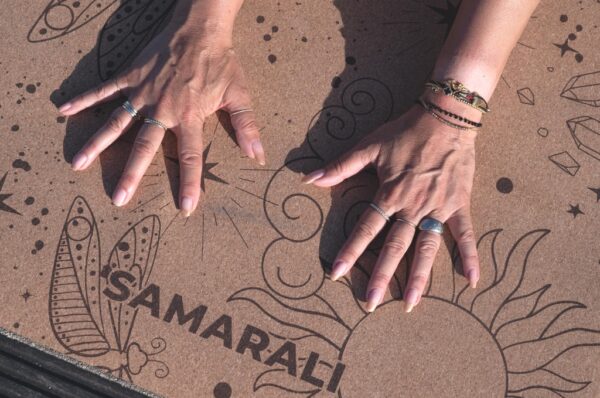
Your mat is the foundation of every session. For Vinyasa specifically, grip matters more than in slower styles because you will be moving through sequences like sun salutations where your hands and feet shift position repeatedly. A natural rubber yoga mat offers excellent traction and stays stable even when you start to sweat. If you prefer a more traditional feel, an organic cotton yoga rug works beautifully for home practice on a non-slip surface.
Helpful but optional props
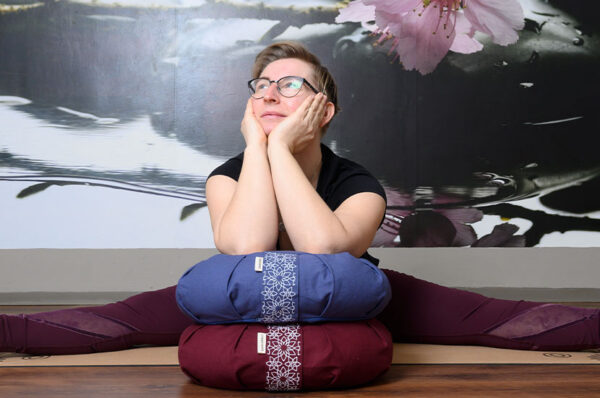
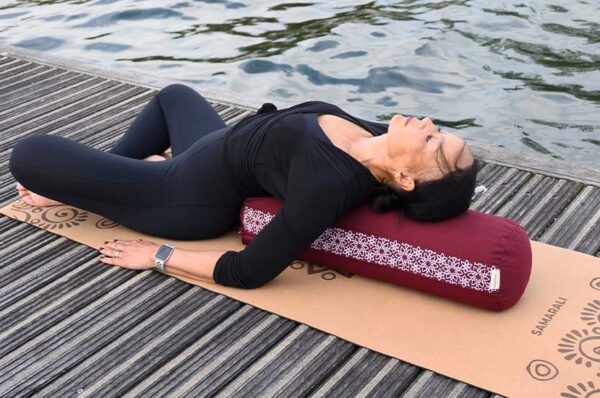
Two yoga blocks give you something to rest your hands on when poses like triangle or half-moon feel out of reach. A yoga strap helps you maintain proper form in seated forward folds without straining your lower back. A yoga bolster is wonderful for restorative poses at the end of a session, supporting your body fully so you can relax completely. None of these are required to start, but they become increasingly useful as your practice deepens.
How much space do you need to practice Vinyasa yoga at home?
You need a space roughly the size of your yoga mat plus about one arm’s length of clearance on each side. In practical terms, that means a clear floor area of approximately 2 by 3 meters is enough for a full Vinyasa practice. You do not need a dedicated studio or a large room.
The key is that the space is genuinely clear. Vinyasa sequences involve poses where your arms extend fully overhead, out to the sides, and behind you, so furniture, shelves, or low ceilings can get in the way quickly. Before your first session, walk the perimeter of your mat and test a few wide-arm poses to check for obstacles.
Flooring matters too. A firm, flat surface like hardwood, tile, or a low-pile rug gives your mat the stable base it needs. Very thick carpeting can make balance poses unstable and reduce the grip of your mat, so if that is what you have, consider placing a thin non-slip underlay beneath your mat.
What should you wear for a Vinyasa yoga session at home?
For Vinyasa yoga at home, wear form-fitting or close-fitting clothing that moves with your body without bunching or riding up. Because Vinyasa involves frequent forward folds, inversions, and transitions to the floor, loose or baggy clothing tends to shift out of place and become distracting mid-flow.
Breathable, stretchy fabrics are ideal. Leggings or fitted shorts work well for the lower body, and a fitted top or sports bra keeps everything in place during downward dog and other inverted positions. Since you are practicing at home, you also have the freedom to dress purely for comfort rather than appearance, so prioritize how the clothing feels over how it looks.
Feet are always bare in yoga. Bare feet give you the grip and sensory feedback you need to root through your standing poses and feel the connection to your mat. Socks reduce that feedback significantly and make balancing poses harder.
One practical note: if your home is cool, have a light layer nearby for the final relaxation pose at the end of your session. Your body temperature drops when you stop moving, and staying warm during savasana helps you relax fully.
How do you structure a Vinyasa yoga practice at home as a beginner?
As a beginner, structure your home Vinyasa practice in three parts: a short warm-up, a flowing sequence of linked poses, and a cool-down with a final rest. A session of 20 to 30 minutes built this way is far more effective than an unstructured hour of random poses.
Warm-up (5 minutes)
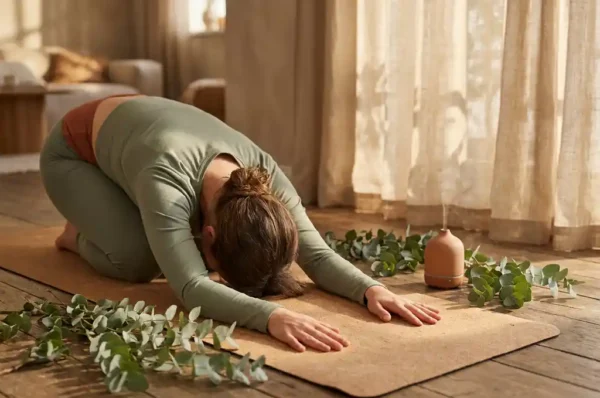
Begin seated or lying down and spend a few minutes connecting to your breath. Move into gentle neck rolls, cat-cow stretches, and child’s pose to wake up your spine. The goal is to bring awareness into your body before you ask it to work harder. Rushing this stage is one of the most common beginner mistakes and makes the flowing portion feel much more difficult.
Main flow (15 to 20 minutes)
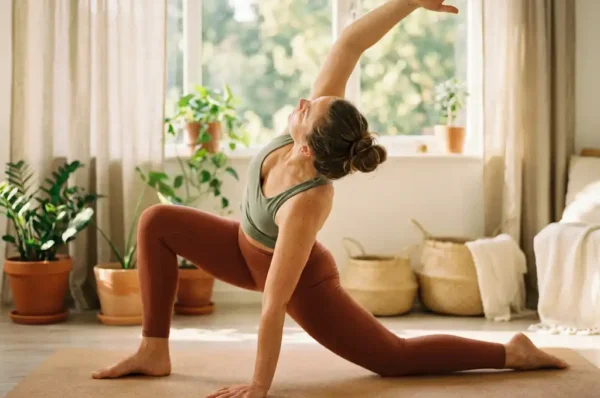
Sun salutations are the backbone of most Vinyasa classes, and they make an excellent starting point for home practice. Begin with three to five rounds of Sun Salutation A, moving each transition with a breath: inhale to lengthen, exhale to fold or lower. Once that feels familiar, you can add standing poses like warrior one, warrior two, and triangle into your flow. Online classes and video guides are genuinely useful here because Vinyasa is easier to learn by watching than by reading instructions.
Cool-down and rest (5 minutes)
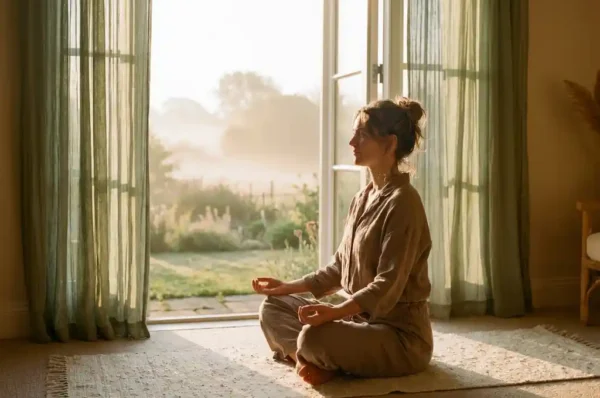
End every session with a few minutes of seated forward folds or supine twists to release tension from your hips and lower back, then lie flat in savasana for at least two to three minutes. This final rest is not optional filler. It is where your nervous system integrates the work you have done, and skipping it leaves your body in an activated state rather than a recovered one.
As your confidence grows, you can explore our full range of yoga mats and props to support a more developed practice. But for now, consistency matters far more than equipment. Even a simple 20-minute flow three times a week will build real strength, flexibility, and body awareness over time.
Frequently Asked Questions
How do I know if I'm doing Vinyasa poses correctly without a teacher watching me?
The most reliable tool for self-correction at home is video. Set up your phone or a mirror so you can review your form during or after a session. Many free beginner Vinyasa classes on YouTube include detailed alignment cues you can pause and apply in real time. Over time, developing body awareness — noticing where you feel tension, strain, or instability — becomes your most valuable guide, and that awareness sharpens naturally with consistent practice.
How often should I practice Vinyasa yoga at home as a beginner, and how quickly will I see progress?
Three sessions per week is an ideal starting frequency for beginners — it gives your body enough stimulus to adapt while allowing adequate recovery between sessions. Most people notice meaningful improvements in flexibility, balance, and breath control within four to six weeks of consistent practice. Progress feels gradual day to day but becomes obvious when you look back at where you started a month earlier.
What should I do if a pose feels painful or I can't complete a full sun salutation yet?
Pain is always a signal to stop, back off, and modify — never push through it in yoga. If a full sun salutation feels too demanding, break it into individual poses and practice them separately before linking them with breath. Modifications like dropping your knees in low plank (chaturanga) or bending your knees in forward folds are not shortcuts; they are smart progressions that protect your body and build the strength you need to advance safely.
Can I practice Vinyasa yoga at home if I have no prior yoga experience at all?
Yes, but starting with one or two beginner-specific Vinyasa classes online before practicing independently is strongly recommended. Vinyasa links movement to breath, and understanding that rhythm from the start will make every session more effective and far less frustrating. Look for classes explicitly labelled ‘beginner’ or ‘slow flow’ rather than general Vinyasa classes, which often assume some foundational knowledge of common poses.
Is a more expensive yoga mat actually worth it for home practice?
For Vinyasa specifically, investing in a mid-to-high quality mat is worth it because grip and durability directly affect your safety and comfort during dynamic movement. A mat that slips during downward dog or wears out within a few months will undermine your practice and cost more to replace repeatedly. You do not need the most premium option available, but avoiding the cheapest mats — which typically use PVC and offer poor traction — is a practical decision that pays off quickly.
What are the most common mistakes beginners make when starting a home Vinyasa practice?
The three most common mistakes are skipping the warm-up, holding the breath during challenging poses, and trying to keep up with intermediate-level online classes too soon. Rushing into movement without warming up increases injury risk significantly, and disconnecting breath from movement removes the core element that makes Vinyasa different from general exercise. Starting with slower, beginner-friendly flows and genuinely prioritising breath over pose complexity will build a far stronger foundation than pushing hard from day one.
How do I stay motivated to keep practicing at home when there's no class schedule or instructor to keep me accountable?
Building a consistent home practice is primarily a scheduling and environment challenge, not a willpower one. Choosing a fixed time slot each day — even just 20 minutes in the morning before other commitments take over — removes the daily decision of when to practice. Keeping your mat unrolled and visible in your practice space also lowers the friction of starting. Many practitioners find that joining an online yoga community or following a structured 30-day beginner program provides the external accountability that a studio class naturally offers.