


Transitioning from beginner to intermediate yoga requires consistent practice, patience, and gradual progression over 6–18 months. You’ll know you’re ready when you can hold basic poses comfortably, understand proper alignment, and maintain steady breathing throughout your practice. The key lies in building strength, flexibility, and confidence while listening to your body’s signals and avoiding rushed advancement that could lead to injury.
How long does it actually take to progress from beginner to intermediate yoga?
Most practitioners transition from beginner to intermediate yoga within 6 to 18 months of regular practice. This timeline assumes you’re practicing 2–3 times per week with proper instruction and consistency. However, everyone progresses at their own pace based on individual factors.
Several key factors influence your progression speed:
- Starting fitness level: Your existing strength, flexibility, and cardiovascular health determine how quickly your body adapts to yoga’s physical demands
- Previous movement experience: Background in dance, sports, or martial arts often accelerates learning due to established body awareness and coordination
- Age and natural flexibility: While these play a role, they’re less important than consistency and proper technique in determining advancement
- Practice frequency: Three 30-minute sessions weekly typically produce better results than one 90-minute weekly class due to regular reinforcement
- Quality instruction: Proper guidance helps develop correct alignment and prevents bad habits that can slow progress significantly
These factors work together to create your unique progression timeline, which is why some practitioners advance faster while others need more time to build the necessary foundation. Remember that yoga emphasizes sustainable development over quick achievements—your body needs adequate time to build strength, flexibility, and neuromuscular coordination safely, and rushing this process often leads to setbacks through injury or burnout.
What are the signs you’re ready to move beyond beginner yoga?
You’re ready for intermediate yoga when you can hold basic poses for 5–8 breaths comfortably, understand proper alignment cues, and maintain steady breathing throughout your practice. Physical and mental readiness indicators work together to signal your progression.
Key physical benchmarks include:
- Sustained holds: Maintaining downward dog for one minute without strain or trembling
- Fluid sequences: Completing sun salutations smoothly with coordinated breath and movement
- Basic balance: Demonstrating stability in tree pose for at least 30 seconds on each side
- Adequate flexibility: Achieving comfortable forward folds and gentle backbends without forcing or bouncing
- Core strength: Supporting your spine effectively in various positions without collapsing or overarching
Equally important mental and awareness markers include:
- Alignment understanding: Knowing how to engage your core and position your spine correctly across different poses
- Breath control: Maintaining steady, rhythmic breathing during challenging sequences rather than holding your breath or gasping
- Modification skills: Recognizing when to adjust poses and distinguishing between productive challenge and harmful strain
- Body awareness: Developing the sensitivity to feel proper alignment and recognize your physical limits
- Practice confidence: Feeling comfortable in beginner classes and having established a personal routine outside formal instruction
These physical and mental indicators demonstrate that you’ve built the foundational strength, flexibility, and awareness necessary for more challenging poses, creating a solid platform for intermediate practice that prioritizes safety alongside advancement.
Which intermediate yoga poses should you learn first?
Begin with crow pose, side plank, and warrior III as your first intermediate poses. These build naturally from beginner foundations while introducing new strength and balance challenges. Each prepares your body for more advanced variations later.
Essential first intermediate poses include:
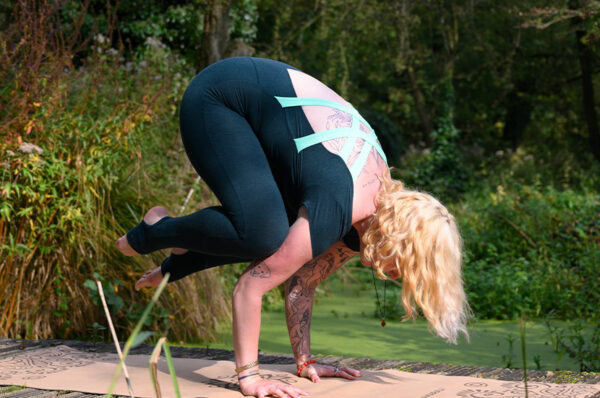
- Crow pose (Bakasana): Develops arm and core strength while teaching weight distribution and balance—start by squatting with hands planted firmly, then gradually shift weight forward until toes lift
- Side plank (Vasisthasana): Progresses from standard plank by adding rotational stability challenges—begin with knees down if needed, building toward full side plank to strengthen obliques
- Warrior III (Virabhadrasana III): Challenges single-leg balance while strengthening the entire posterior chain—use wall or chair support initially, gradually reducing assistance as stability improves
- Revolved triangle (Parivrtta Trikonasana): Introduces spinal rotation and deep balance while building on basic triangle pose foundations
- Forearm stand prep: Builds shoulder strength and teaches inversion basics through wall-supported practice before attempting full forearm stand
These poses create a comprehensive foundation for intermediate practice by addressing the key elements of arm balance, core stability, single-leg balance, spinal rotation, and inversion preparation. Practice each pose gradually over several weeks, focusing on proper alignment and breath control before adding variations or progressing to more challenging options, and consider using quality yoga mats that provide proper grip and cushioning to support your advancing practice safely.
How do you avoid injury when advancing your yoga practice?
Prevent injury by warming up thoroughly, progressing gradually, and listening to your body’s signals. Most yoga injuries occur when practitioners push too hard too fast or ignore pain signals. Smart progression keeps you practicing safely for years.
Essential injury prevention strategies include:
- Proper warm-up routine: Always begin with gentle movements like sun salutations and basic stretches to prepare muscles and joints for deeper work
- Pain recognition: Distinguish between productive challenge (muscle engagement, gentle stretching, mild trembling) and harmful pain (sharp sensations, joint discomfort, shooting pains)
- Balanced strength and flexibility: Build muscular endurance alongside flexibility to protect joints when they’re in extended ranges of motion
- Progressive loading: Increase pose difficulty and duration gradually over weeks rather than attempting advanced variations immediately
- Recovery integration: Include rest days and vary your routine to prevent repetitive stress injuries from identical daily sequences
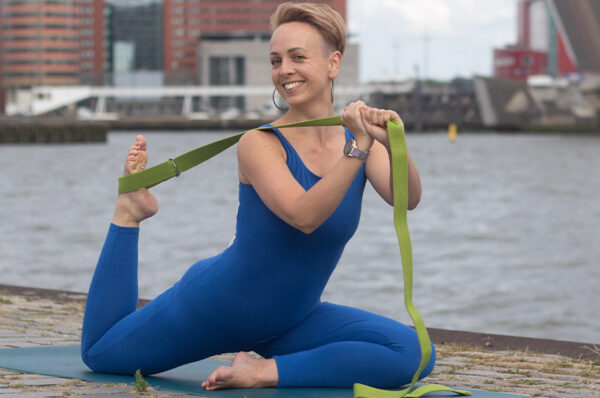
- Prop utilization: Use blocks, straps, and yoga bolsters to achieve proper alignment while building toward full expressions safely
These prevention strategies work together to create a sustainable practice environment where your body can adapt and strengthen progressively without experiencing the setbacks that come from overuse or forced advancement. By developing sustainable practice habits that prioritize long-term health over short-term achievement, you build the foundation for a lifelong yoga practice that continues to serve your physical and mental well-being.
Your yoga journey from beginner to intermediate represents months of dedicated practice and mindful progression. Remember that sustainable advancement serves you better than rushed achievement. Focus on building strong foundations, listening to your body, and enjoying the process of gradual improvement. Consider investing in complete yoga sets that provide all the essential props you need for safe progression, supporting your practice with sustainable materials made from organic cotton and packaged without plastic to align with mindful living values that honor both personal wellness and environmental responsibility.
Browse our selection of thoughtfully crafted collection of sustainable yoga essentials—designed for mindful movement and made with respect for the planet.