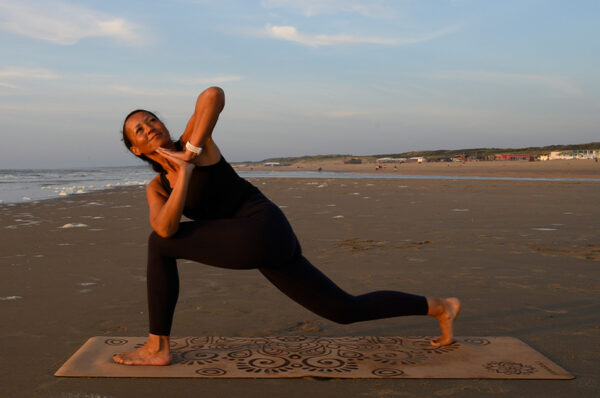



For balance poses, a 4–6 mm yoga mat thickness provides the optimal foundation for stability and ground connection. This range offers enough cushioning to protect your joints while maintaining the proprioceptive feedback necessary for challenging poses like tree pose and warrior III. Thicker mats can compromise your ability to feel grounded, while thinner mats may lack adequate joint support during extended practice sessions.
What thickness yoga mat do you actually need for balance poses?
The ideal thickness for balance poses falls within the 4–6 mm range for several key reasons:
- Optimal cushioning balance – This thickness provides sufficient joint protection without creating an unstable, spongy surface that interferes with balance feedback
- Enhanced proprioception – Your feet can sense subtle weight shifts and ground connection, allowing your nervous system to make micro-adjustments for stability
- Pose-specific support – Perfect for challenging poses like tree pose, eagle pose, and warrior III where ground connection is crucial
- Environmental adaptability – Works well on various surfaces, with 6mm better for hard floors and 4mm suitable for carpeted areas
This thickness range creates the ideal foundation for developing and maintaining balance skills while ensuring your joints remain protected during extended practice sessions. The key is maintaining that crucial connection between your feet and the stable surface below, which thicker mats tend to disrupt.
How does mat thickness affect your stability during challenging poses?
Mat thickness directly impacts your proprioception—your body’s ability to sense its position in space. During challenging balance poses, several factors come into play:
- Sensory feedback transmission – Thinner mats allow better ground connection, enabling your feet to send crucial balance information to your brain
- Signal dampening effects – Thick mats act as barriers, reducing the important sensory signals your body needs for micro-adjustments
- Compression consistency – Quality materials in the 4–6 mm range maintain stable support without excessive compression under pressure
- Material advantages – Natural rubber yoga mats often provide better stability than foam alternatives due to their superior density and compression resistance
This enhanced proprioceptive feedback becomes especially critical during advanced poses like warrior III or standing figure four, where your body constantly makes subtle adjustments to maintain stability. The right mat thickness preserves this vital communication system between your feet and brain while still protecting your joints from hard surfaces.
What’s the difference between thick and thin yoga mats for balance work?
Different mat thicknesses serve distinct purposes in balance practice:
- Ultra-thin mats (1–3 mm) – Maximize ground connection and stability feedback but offer minimal joint cushioning, ideal for advanced practitioners prioritizing balance precision
- Standard thickness mats (4–6 mm) – Provide optimal balance between stability and comfort, maintaining good proprioceptive feedback with adequate joint protection for most practitioners
- Thick mats (8 mm+) – Prioritize cushioning over stability, excellent for restorative poses but can significantly compromise balance feedback in standing poses
- Material density considerations – Dense, natural materials like rubber provide superior stability compared to soft synthetic foams, even at similar thicknesses
The standard thickness range emerges as the clear winner for balance work, offering the versatility to support practitioners at all levels while maintaining the stability feedback essential for challenging poses. Material quality becomes equally important, as consistent density prevents uneven compression that could compromise your balance over time.
Should beginners use different mat thickness than experienced yogis for balance poses?
The thickness needs for balance poses remain surprisingly consistent across skill levels:
- Beginner development – Starting with 4–6 mm mats helps new practitioners develop proper proprioceptive awareness from the beginning, creating stronger foundations
- Learning acceleration – Appropriate thickness provides clear feedback about weight distribution, helping beginners develop subtle muscle control and body awareness faster
- Experienced preferences – Advanced practitioners might choose slightly thinner options (around 4 mm) but still benefit from the 4–6 mm range
- Universal applicability – This thickness range eliminates the need to change mats as skills advance, making it a practical long-term choice
Rather than compensating for inexperience with extra thickness, beginners benefit more from quality materials and proper thickness that supports skill development. This approach ensures that balance abilities develop naturally while maintaining joint protection, creating a sustainable practice foundation that grows with the practitioner.
Choosing the right mat thickness for balance poses comes down to finding that optimal middle ground between stability and comfort. The 4–6 mm range serves most practitioners well, providing the ground connection you need for challenging poses while protecting your joints during longer practices. We at Samarali create our sustainable yoga mats with this balance in mind, using organic cotton and plastic-free packaging to support both your practice and your environmental values. Remember that developing balance skills takes time regardless of your mat choice, so focus on consistent practice and trust the process.
Browse our selection of thoughtfully crafted collection of sustainable yoga essentials—designed for mindful movement and made with respect for the planet.